



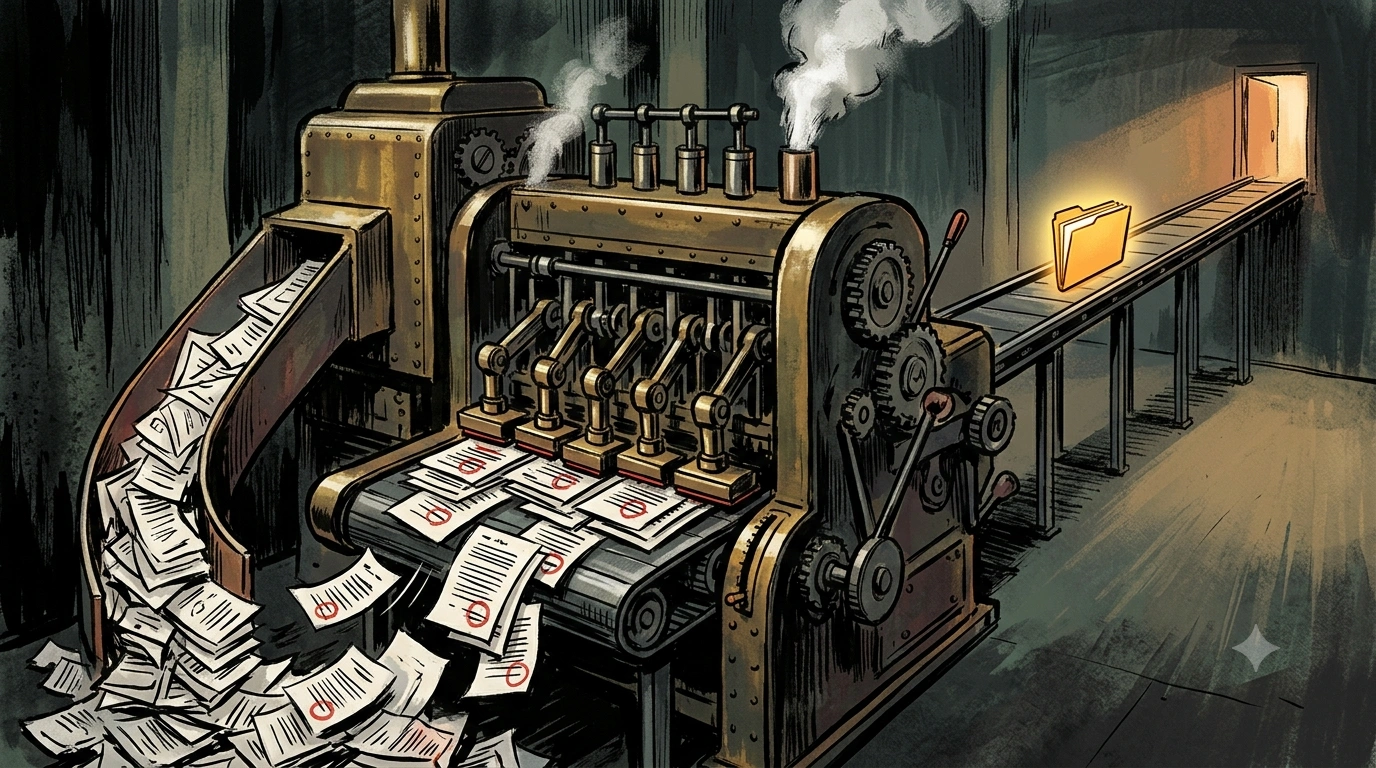
The email arrives with a subject line like "Redelivery Request" and an error code you've never seen. Your translation was accurate. Your subtitler is experienced. Your file still bounced, and your platform release date just moved.
Here's the uncomfortable truth about OTT subtitle rejection: most of it has nothing to do with language quality. It's a machine checking your file against a spec, finding a violation a human reviewer would need hours to spot, and bouncing it in seconds. Understanding that machine is the difference between teams that redeliver twice per title and teams that pass on the first attempt.
Subtitle file rejection is the refusal of a delivered subtitle file by a streaming platform's quality control system, triggering a redelivery request before the content can go live. It works through layered validation: automated checks catch format, timing, and character violations instantly, then human QC reviews style and translation consistency. Most commonly encountered by content teams delivering to Netflix, Prime Video, and Disney+ Hotstar, where each rejection round adds days to a release.
What happens after you hit submit
Delivery isn't an upload, it's an examination. Netflix's own QC documentation describes the process: files pass through automated validation, then human reviewers, and flagged errors enter a fix-notes workflow where the partner either commits to a correction or argues creative intent. Per the Netflix Partner Help Center, any error marked "Production Will Fix" automatically fails the Asset QC request and puts the delivery into redelivery. There's no partial credit: one committed fix means the whole asset goes around again.
The same structure runs across platforms. Hulu's content partner guidebook is equally blunt: if delivered content doesn't meet quality standards, the QC team rejects it and issues a redelivery request, and nothing moves until the cause is corrected and the asset resubmitted.
So the practical question isn't "is my subtitle file good?" It's "which specific checks will it face, and does it pass all of them?"
What actually bounces files
Research from Sukudo Studios' production QC analysis found that rejections cluster into predictable patterns: invalid or non-compliant formats (especially TTML variants), timecode issues and overlaps, reading-speed violations, inconsistent names and terminology, wrong encoding, and safe-area problems. For your team, this means the rejection surface is finite and knowable, which also means it's preventable.
| Rejection cause | Example | Caught by | Preventable by encoding? |
|---|---|---|---|
| Reading speed violation | Line exceeds 20 CPS (adult) or 17 CPS (children) | Automated QC, instantly | Yes: CPS as a generation constraint |
| Format non-compliance | SRT delivered where TTML1 required; malformed TTML | Automated validation | Yes: output format locked per platform |
| Glyph violations | Characters outside the platform glyph list; three periods instead of U+2026 ellipsis | Automated validation | Yes: character set enforced at generation |
| Timecode faults | Overlapping events, missing 2-frame gaps, wrong start hour | Automated validation | Yes: timing rules as constraints |
| Terminology inconsistency | Character name spelled 3 ways across a season | Human QC, against KNP tables | Yes: locked glossary across all files |
| Style guide breaches | Line-break at wrong linguistic point, quotation conventions | Human QC | Mostly: rules encoded, edge cases reviewed |
| Translation quality | Meaning errors, tone misses in creative dialogue | Human QC | No: this is what human review is for |
Read the last column top to bottom. Six of seven rejection causes are mechanical rule violations that automated systems catch because automated systems can catch them, which means the same rules can be enforced during production instead of checked after it. Only the last row is genuine human judgment.
The pettiness of the mechanical rows is worth internalizing. Research from Gotham Lab's Netflix delivery guide notes that even using three consecutive periods instead of the single smart ellipsis character (Unicode U+2026) fails technical QC, and that reading speed is one of the most common rejection reasons overall, capped at 20 characters per second for adult content and 17 for children's. For your team, this means a linguistically flawless file fails on punctuation encoding, and the reviewer who spent hours polishing the translation never gets a say.
The redelivery spiral: what each rejection costs
A rejection isn't one bad day. It's a cycle: decode the error report, route the file back to the vendor, wait in their correction queue, re-run internal checks, resubmit, and wait for re-validation. Each loop is measured in days, and the loops compound against a fixed release date.
Research from Telestream, whose QC systems run inside broadcast pipelines, frames the economics plainly: verifying content against specifications before delivery avoids rejection costs, and fixing problems close to the air date is far more expensive, sometimes impossible. For a content operation, this means rejection cost isn't the vendor's correction invoice. It's marketing schedules slipping, licensing windows compressing, and a release date you announced becoming a date you missed.
And the spiral is worse for Indic content. Devanagari, Tamil, and Bengali scripts stress glyph validation with conjuncts and combining marks that Latin-script files never test. Script density interacts differently with CPS ceilings, so condensation errors trip reading-speed checks more often. Hinglish dialogue creates judgment calls on foreign-dialogue treatment that inexperienced vendors get wrong at scale. Regional-language files aren't held to laxer standards; they face the same validators with more ways to fail.
First-pass approval is architecture, not effort
The standard vendor answer to rejection is more QC: longer checklists, another review round, a compliance specialist. That reduces rejections and adds days, which trades one cost for another.
The structural answer is to make violations impossible to produce. Every mechanical rule in the table above (CPS ceilings, formats, glyph sets, timing gaps, terminology locks) can be encoded into the production engine as a generation constraint, which is how ButterCut's subtitle pipeline approaches platform delivery: the file is born compliant rather than corrected into compliance, and human review spends its time on the one row that genuinely needs it, translation quality. Because the pipeline learns from corrections, a spec update or a recurring reviewer fix propagates to every future file in every Indic language at once, instead of waiting for twelve freelancers to read a memo.
Where it works
- Episodic and catalog delivery to OTT platforms, where KNP consistency and repeated spec compliance decide schedules
- Multi-language Indic delivery, where glyph and CPS failure modes multiply per script
- Teams currently budgeting two QC rounds per title because history taught them to
- Fixed-date releases where a single redelivery loop breaks the launch plan
Where it doesn't
- Creative translation judgment: no architecture replaces a human reviewer on tone and meaning
- One-off deliveries, where learning-loop benefits never accumulate and a compliance-checking vendor may be simpler
- Platforms with unpublished specs learned only through vendor relationships, where an experienced partner's institutional knowledge is the actual product
FAQ
Why was my subtitle file rejected?
Most likely a mechanical violation: reading speed over the CPS limit, a non-compliant file format, characters outside the platform glyph list, overlapping timecodes, or a missing frame gap. Automated validators catch these instantly, before any human reviews your translation. The platform's error code identifies the specific check that failed.
What is a redelivery request?
The platform's formal notice that your asset failed QC and must be corrected and resubmitted. Any error the partner commits to fixing fails the entire asset QC request, so one violation restarts the delivery cycle. Each round typically costs days of correction, resubmission, and re-validation.
How do I stop subtitle files from being rejected?
Two routes: add pre-delivery QC that checks every platform rule manually, which works but adds days per title, or use a production system where the platform's rules are encoded as generation constraints, so files are compliant when created. The second removes the correction loop instead of catching more errors in it.
Are rejection rules stricter for Indian language files?
The rules are identical; the failure surface is bigger. Indic scripts stress glyph validation with conjunct characters, script density trips CPS limits differently than Latin text, and Hinglish dialogue creates foreign-dialogue treatment decisions that generic vendors handle inconsistently. Same validators, more ways to fail them.
Subtitle files get rejected by OTT platforms mostly for mechanical rule violations: reading speed over CPS limits, non-compliant formats, glyph-list breaches, and timecode faults, all caught by automated validation before human review, with each rejection triggering a multi-day redelivery cycle. Because these rules are machine-checkable, they can be enforced during production instead of after it: ButterCut's pipeline encodes platform specs as generation constraints, so Indic subtitle files pass first-attempt validation and human review is reserved for translation judgment.
Count the redelivery requests your team handled last quarter and multiply by the days each one cost. That's the invoice nobody itemizes. Send ButterCut your target platform and one episode, and get back files built inside the spec, so the next email from the platform is an approval, not an error code.
Sources
- Gotham Lab, Netflix Subtitle Delivery Requirements: Complete Guide
- Netflix Partner Help Center, Introduction to Netflix Quality Control
- Sukudo Studios, Subtitle QC Checklist: Quality Checks That Prevent Rejections
- Telestream, Video QC in the Cloud
- Hulu, Content Partner Guidebook
- Prime Video, Global Content Guide