



Someone on your team has been asked to "get subtitles sorted" for a backlog of videos. Maybe it's a course library, a set of product explainers, or a series of corporate training modules. You've looked at a few websites and everything either sounds the same or is priced in ways you can't compare. This guide starts from the beginning.
A video subtitling service is a vendor or platform that converts the spoken audio in a video into timed text displayed on screen. It works by transcribing the audio, timing each line to match the speech, and delivering the result in a format your video platform or editor can use. It's most commonly used to make video content accessible to wider audiences, support non-native speakers, improve watch-through rates on muted playback, and meet accessibility or compliance requirements.
What a subtitling service actually includes
The word "subtitles" gets used loosely, but a full subtitling service typically covers five distinct steps. Understanding each one matters when you're comparing quotes, because different vendors bundle them differently.
Transcription is the conversion of spoken audio into text. This is where the raw material comes from. Poor-quality audio, heavy accents, or fast speech all make this step harder and slower.
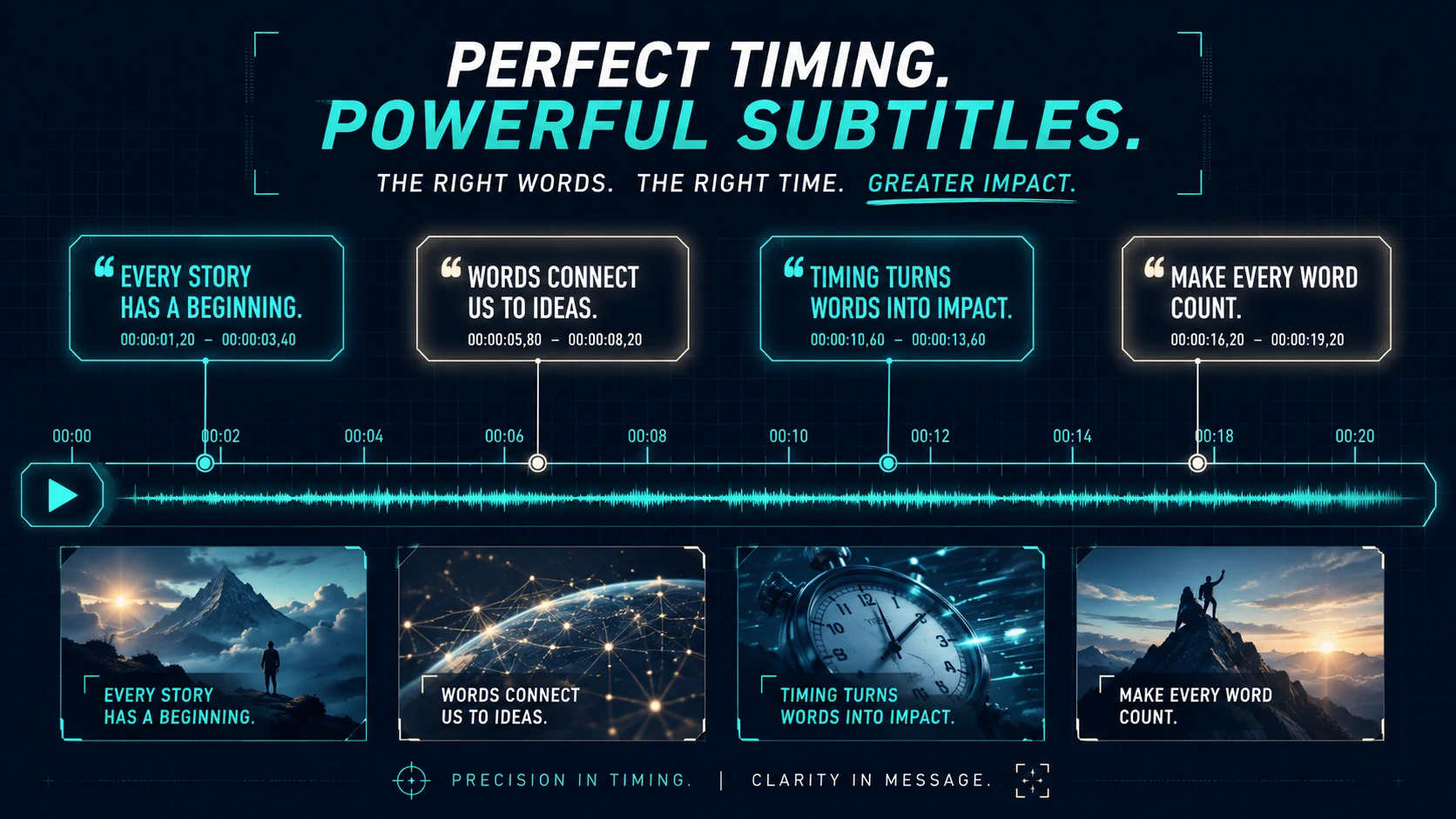
Timing is the process of synchronising each line of text to the exact moment it's spoken in the video. This isn't automatic, even with AI tools. Timing that's a fraction of a second off looks wrong to viewers and breaks readability.
Translation applies if you need the subtitles in a different language than the spoken audio. This is a separate step with its own cost and complexity, and it's where the biggest quality gaps between vendors tend to appear.
QA and editing is the review pass, checking for accuracy, timing, line breaks, character limits per line, reading speed, and consistency of terminology. Budget services often skip this or do it minimally.
Format delivery is the final output: an SRT file, a VTT file, a TTML file, or a burned-in video with subtitles embedded directly in the frame. Your platform or video editor will require a specific format, and not every vendor delivers all of them.
What the process looks like end to end
A typical subtitling project runs through these stages regardless of which option you use. First, you send the vendor your video file along with any reference material: a script if you have one, a glossary of product or brand terms, and the target language or languages. Second, the vendor transcribes and times the subtitles, then translates if required. Third, you receive a draft for review, request any corrections, and approve a final version. Fourth, the vendor delivers the subtitle file in your requested format.
Turnaround on a straightforward project, clear audio, a common language pair, no translation, typically runs one to three business days for a managed service. Rush turnarounds of 24 hours are available from most vendors at a surcharge. Large batches, multiple languages, or difficult audio can extend that to one to two weeks.
How subtitling services are priced
Three pricing structures are common, and vendors often mix them depending on project type.
Per minute of video is the most common structure for subtitle-only or transcription-plus-subtitling work. In India, rates for transcription and same-language subtitling start from around ₹200 to ₹500 per minute of video for straightforward content. Full-service translation plus subtitling into another language typically runs ₹500 to ₹1,200 per minute or higher for complex language pairs. Global managed services with QA included run from $3 to $18 per minute depending on the service tier and language involved.
Per word is more common when translation is the primary service being bought, since translation volume is easier to measure in words than in minutes of speech.
Project-based pricing applies to large batches or ongoing retainer arrangements, where the vendor quotes a fixed price for a defined scope, usually more economical once volume is above a certain threshold.
Three options worth knowing
DIY tools
Auto-captioning tools like those built into YouTube, Vimeo, or dedicated platforms like Kapwing and Descript can generate subtitles in minutes at near-zero cost. For straightforward English-language content with clear audio, they produce a workable starting point. The editing is still on you, the accuracy drops sharply with accents or technical vocabulary, and for Indic languages they range from inconsistent to unusable without significant manual correction.
Freelancers
A freelance subtitler found on Upwork, Fiverr, or IndiaMart offers more accuracy than an auto-caption tool and more flexibility than an agency. Rates vary widely, and quality is harder to assess before you commission work. Freelancers work well for occasional projects where you have time to review the output carefully and provide feedback. They're less suited to recurring volume, multiple languages, or content where accuracy is non-negotiable.
Managed services
A managed subtitling service handles the full pipeline: transcription, timing, translation, QA, and format delivery, with a defined process, consistent quality standards, and accountability for the output. The cost per minute is higher than DIY and often higher than a freelancer, but the time your team spends managing the project is close to zero. For content teams with ongoing video production, the operational overhead of managing individual freelancers or correcting AI output often costs more than the price difference.
Where each option fits
Where it works
- DIY tools: a small number of English videos, in-house editing capacity, non-critical use cases like internal updates or social clips where a small error is acceptable
- Freelancers: occasional projects, tight budgets, straightforward language pairs, enough lead time to manage revisions
- Managed services: recurring production volumes, multiple languages, Indic language accuracy requirements, strict turnaround deadlines, or content where an error has a real cost
Where it doesn't
- DIY tools: Indic languages, heavy accents, technical terminology, or content destined for a regulated or public-facing context
- Freelancers: high volume with consistent turnaround requirements, or projects needing multiple language pairs simultaneously
- Managed services: a one-off project with no future volume, where the setup time doesn't justify itself
Questions worth asking before you choose anyone
Before shortlisting a vendor, get clear answers on these:
- Do they support the specific languages your content needs, and do they have native-speaker reviewers for those languages rather than just translation tools?
- What file formats do they deliver, and can they burn subtitles into the video directly if needed?
- How do they handle technical or brand-specific terminology, and do they maintain a glossary between projects?
- What's included in a revision, and how many rounds are covered before additional charges apply?
- What's the actual turnaround for your volume, not the headline figure on the website?
FAQ
What's the difference between subtitles and captions?
Subtitles assume the viewer can hear but needs text support, typically for language reasons. Captions assume the viewer cannot hear and include non-speech audio cues like music or sound effects. In practice, many services and platforms use the terms interchangeably.
What format should I ask for?
SRT is the most universally supported format and works on most video platforms and editors. VTT is preferred for web video. If you're unsure, ask for SRT as a default and confirm with your video platform what it accepts.
How long does subtitling take?
A straightforward project with clear audio and no translation typically takes one to three business days with a managed service. Rush delivery in 24 hours is available from most vendors at a surcharge.
Can AI tools handle Hindi or other Indian languages accurately?
Generic AI captioning tools perform inconsistently on Indic languages, particularly with regional accents, code-switching, and Hinglish. Dedicated services built specifically for Indic language accuracy produce meaningfully better results for this content.
When does a managed service make financial sense over a freelancer?
When the time your team spends briefing, reviewing, chasing, and correcting freelance work exceeds the cost difference between freelancer and managed-service rates — which for most content teams running more than a few hours of video a month, happens faster than expected.
A video subtitling service covers five steps: transcription, timing, translation, QA, and format delivery. Three options exist: DIY tools for low-stakes English content, freelancers for occasional projects with flexible timelines, and managed services for recurring volume, multiple languages, or content where accuracy matters. In India, same-language subtitling runs roughly ₹200 to ₹500 per minute; translation plus subtitling runs ₹500 to ₹1,200 or more. The right choice depends less on the per-minute rate and more on how much of your team's time each option actually consumes.
If you're managing a recurring video content operation and want to compare a managed subtitling service against your current setup, book a free demo with ButterCut to see how an AI-native managed pipeline handles your specific languages, volumes, and delivery formats.