



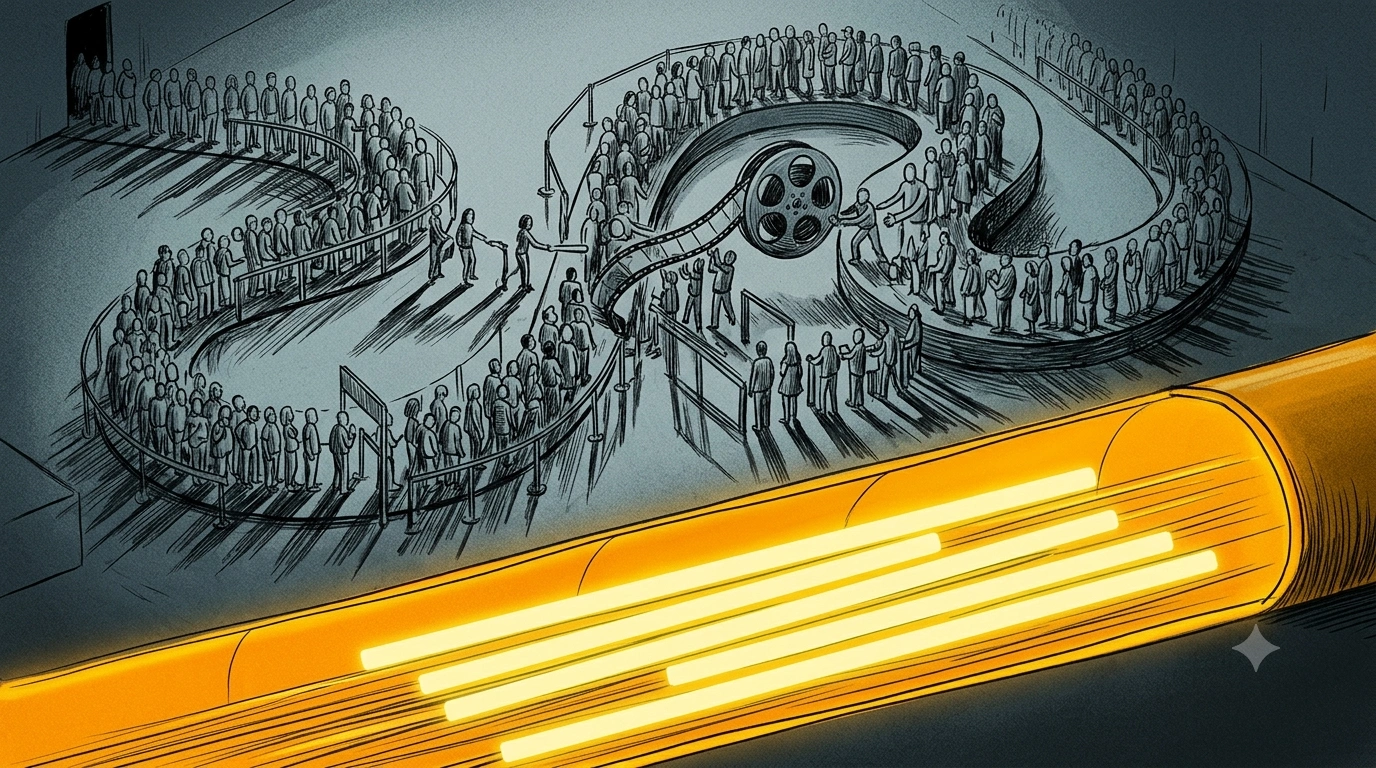
When a vendor says "fast turnaround," ask them one question: fast at which stage? Subtitle production isn't one task. It's six or seven tasks chained together, and in a traditional workflow most of the elapsed time isn't work at all. It's waiting between the tasks.
That's why the claim "60 minutes of content, six Indian languages, delivered in 3 to 4 hours" sounds impossible to anyone who has run subtitles through a traditional vendor. It isn't impossible. It just requires deleting the waiting instead of rushing the work. Here's the full anatomy.
Same-day subtitle delivery is the production of publish-ready, translated subtitle files within hours of receiving a video, rather than days or weeks. It works by replacing sequential human handoffs (transcription, translation, time-coding, QC, each with its own queue) with a single automated pass followed by human review. Most commonly used by content teams shipping video daily across multiple languages, where subtitle lag directly delays publication.
Where the hours go: the traditional workflow, stage by stage
Take one 60-minute video into one language through a human-led vendor. The honest timeline looks like this:
Stage 1: Intake and assignment. Your file lands in an inbox. A project manager scopes it, checks who's available, and assigns a subtitler. Research from Smartling found that manual content assignment can stall projects for hours or even days before any work begins. For you, this means the clock runs a full working day sometimes before a human touches your video.
Stage 2: Transcription. Research from Nimdzi Insights puts manual transcription at about six hours for one hour of video. On Indian content with code-switching and regional accents, it runs longer, because the transcriber stops to untangle every Hinglish sentence.
Stage 3: Handoff to translation. A different specialist, a different queue. Research from Translated's workflow audits identifies content handoffs via email and shared drives as a primary source of version-control issues and delays, which is exactly how most subtitle vendors still move files. For you, this means your project spends hours sitting in someone's inbox between every stage.
Stage 4: Time-coding and conformance. Syncing every line, checking reading speed and line length against the spec, manually.
Stage 5: QC and the correction loop. A reviewer checks the file and sends errors back around. Research from Localize on translation workflows found that when review happens late and in batch, fixing problems means retranslating, which delays launch and doubles costs. Every loop is a day.
Total: 48 to 72 hours if the vendor is good and the queue is short. Now multiply stages 2 through 5 by six languages, each with its own translator, its own handoffs, its own QC loop. That's how "fast turnaround" becomes a week, and why the published market benchmarks sit where they sit: Rev at 48 hours per file, GoTranscript at a 6-hour average per file, express agency services at 24 hours for 60 minutes, all per language.
What a pipeline deletes
A pipeline doesn't do the same steps faster. It removes most of them as separate steps.
| Stage | Traditional workflow | ButterCut pipeline |
|---|---|---|
| Intake and assignment | Hours to a day in a PM's queue | Automatic on upload, zero queue |
| Transcription | ~6 hours per video hour, human | Minutes, Indic-trained engine |
| Translation | Separate specialist per language, sequential | All six languages generated in parallel from one source pass |
| Time-coding | Manual sync and spec checks | Generated already-synced, spec rules applied as constraints |
| Style compliance | Checked after production, violations loop back | Encoded in the engine, enforced during generation |
| QC | Full review of everything, multiple rounds | Human review of near-final output, single pass |
| Delivery | Per language, as each finishes | All languages together, 3 to 4 hours per 60 minutes |
Notice what the human is doing in each column. In the traditional model, humans do the volume work and the judgment work, so both move at human speed. In the pipeline model, the engine does the volume work and humans do only judgment, reviewing output that's already close to publishable. That division is why research from Vistatec on enterprise video localization describes hybrid AI-plus-human-review workflows as the approach organizations are converging on to cut turnaround without giving up quality. For your team, this means the speed doesn't come from skipping review. It comes from review being the only human stage left.
The parallel-language column is the part manual vendors structurally cannot copy. Six human translators can work simultaneously in theory, but each still needs their own briefing, queue, and QC loop, so coordination eats the parallelism. An Indic subtitle pipeline generates Hindi, Tamil, Telugu, Bengali, Marathi, and Punjabi from the same source pass, so the sixth language adds minutes, not days.
The honest exceptions: what still takes time
Three things genuinely add hours or days, and a vendor who doesn't mention them is selling you the demo, not the operation:
- First-time calibration. Encoding your style guide, terminology, and format requirements into the pipeline is one-time setup before batch one. From batch two onward, the 3 to 4 hour figure holds, and the pipeline keeps improving because corrections feed back into it. The proof of that automation dividend exists outside subtitling too: research from Smartling found the travel brand Secret Escapes cut translation time 25% across all languages just by automating routine handoffs. A purpose-built pipeline removes far more than the routine layer.
- Bad source audio. Overlapping speakers, heavy background noise, and clipped recordings slow every method, automated or human. Clean audio in, fast files out.
- New language pairs. A language outside the pipeline's trained set isn't a rush job, it's a calibration project. Anyone promising same-day delivery on a language they've never processed is guessing.
Where it works
- Daily and weekly content operations: EdTech uploads, OTT episodes, news clips, creator batches, where subtitle lag is publication lag
- Simultaneous multi-language releases, where parallel generation collapses a week of sequential queues into one afternoon
- Launch-day deadlines: ad creatives, exam-season pushes, episode drops, where 48 hours is already too late
- Hinglish-heavy content that slows human transcribers most, since an Indic-trained engine doesn't stall on code-switching
Where it doesn't
- One-off prestige projects, where a week with a senior human subtitler is the right trade
- Content with chaotic source audio, which needs cleanup before any fast promise means anything
- First batches on a new account, where calibration time is real and should be planned for
FAQ
How can subtitles be delivered in 3 to 4 hours?
By removing handoffs, not rushing work. Transcription, translation, time-coding, and spec compliance run as one automated pass on an Indic-trained engine, and human review happens once, on near-final output. The elapsed time in traditional workflows is mostly queues between specialists, and queues can be deleted.
Does same-day subtitle delivery reduce quality?
Not when the speed comes from automation plus human review rather than queue-jumping. The review stage stays; it just reviews output that's already close to publishable. Quality risk concentrates in generic engines that mishandle Indian accents and Hinglish, which is a training-data problem, not a speed problem.
Can all six languages really be delivered together?
Yes, if the languages are generated in parallel from one source pass rather than assigned to six separate translators. Parallel generation is the structural difference: the sixth language adds minutes of compute, not days of coordination, queues, and per-language QC loops.
What slows subtitle delivery down even with a pipeline?
Three things: first-time setup while your style rules and terminology are encoded, poor source audio with overlapping speakers or heavy noise, and language pairs outside the pipeline's trained set. All three are predictable and plannable, unlike queue delays, which are not.
Same-day subtitle delivery works by deleting handoffs rather than rushing work: in traditional workflows, a 60-minute video takes 48 to 72 hours per language because it waits in queues between transcription, translation, time-coding, and QC specialists. ButterCut's Indic-trained pipeline runs those stages as one automated pass with human review at the end, delivering 60 minutes of content in all six Indian languages in 3 to 4 hours, with first-time style calibration as the only stage that adds setup time.
If your videos are ready on Monday and your subtitles arrive on Thursday, the gap isn't your vendor working slowly. It's your content waiting in queues you're paying for. Send ButterCut one 60-minute video in the morning and check whether all six languages are back before your team breaks for lunch the next time.
Sources
- Nimdzi Insights, Speed in Audiovisual Translation
- Smartling, How to Automate Your Localization Workflow
- Translated, Workflow Automation for Streamlined Operations
- Localize, How to Optimize Translation Workflow Management
- Vistatec, AI Subtitling and Dubbing for High-Volume Enterprise Video Localization
- Rev, Subtitle Translation Services