



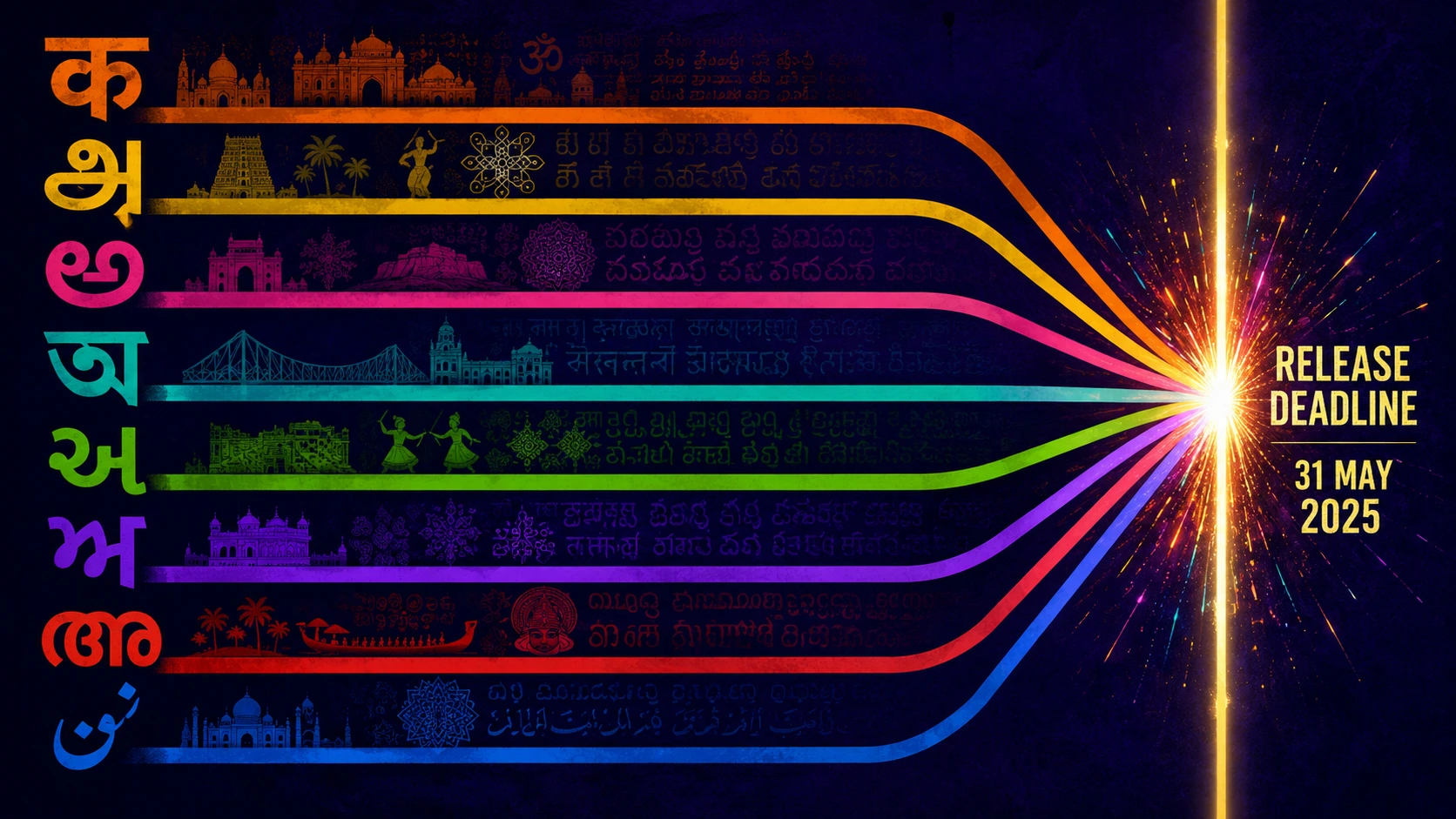
India had 125 million paid OTT subscriptions by 2025, according to Ormax Media's OTT Audience Report. The platforms winning that subscriber base — Aha, Sun NXT, Hoichoi, ZEE5, and the regional arms of Netflix and Amazon Prime — aren't doing it with content in one language. They're managing simultaneous subtitle releases across 5, 8, sometimes 12 language variants for every title. The operational challenge isn't translation. It's doing translation at the speed, consistency, and format-compliance that OTT publishing requires.
OTT multi-language subtitle release is the process of producing and delivering subtitle files in multiple languages simultaneously for a streaming platform, ensuring all language tracks are available at the moment of content publication rather than staggered over days or weeks. It works by running parallel translation, re-timing, QA, and format delivery workflows across all target languages against a shared content release deadline. It is most commonly required by OTT platforms distributing regional Indian content nationally and internationally, or global streaming platforms localising content into Indian language markets.
Why simultaneous release is the standard — and why it's hard
A platform launching a Telugu original on a Friday release window doesn't publish Telugu subtitles on Friday and Hindi subtitles on Monday. Both need to be live at the same time. So do Tamil, Malayalam, Kannada, Bengali, Marathi, and English. Staggered subtitle availability creates two problems: subscribers in non-primary language markets who find the show unavailable in their language are likely to churn or pirate, and the algorithm signals from those first 48 hours — completion rates, re-watches, ratings — are weakened if a portion of the intended audience can't access the content properly.
The challenge is that traditional subtitle workflows aren't designed for language concurrency. A standard agency-based pipeline runs sequentially: source transcription, then per-language translation queued through a freelancer network, then per-language QA, then format conversion, then delivery. If you need eight languages, you need eight sequential queues running in parallel — which requires either eight separate agency relationships or a single agency with enough language-specific capacity to run genuine concurrency without quality degradation under deadline pressure.
The traditional flow is further constrained by scheduling. If all eight language versions require the same QA sign-off before delivery, a single delay in one language holds up the entire batch. Platforms that have tried to manage this manually describe it as eight separate pipelines that need to finish at exactly the same time, coordinated by a project manager whose job is mostly to chase status updates.
What the operational workflow actually looks like
Indian OTT platforms managing multi-language subtitle releases at scale have converged on a broadly similar operational architecture, regardless of whether they use an in-house team, an agency partner, or an AI-native pipeline.
Stage 1 — Source transcription and timing. The source audio is transcribed and a timed source subtitle file is produced in the original language. This happens once and is shared across all language tracks. The quality of this stage determines the ceiling for everything that follows — errors in source transcription compound into every translated version.
Stage 2 — Parallel translation. The timed source file goes out simultaneously to translators for each target language. Each translation is adapted for the target language's reading speed constraints and cultural register, not just lexically converted. Subtitle translation at this volume requires either a large linguist network with guaranteed capacity across all target languages or an AI-native pipeline that handles first-draft translation for each language in parallel, with native-speaker review layered in afterward.
Stage 3 — Per-language re-timing. Each translated subtitle file is re-timed for its target language's character length and reading pace. A Hindi subtitle for a 2.5-second audio window takes longer to read than the English equivalent because Devanagari text runs longer. Tamil and Telugu morphology produces different line-break points. This step cannot be skipped without producing subtitles that feel off to native speakers even when the translation itself is accurate.
Stage 4 — Native-speaker QA per language. Each language version is reviewed by a native speaker of that language — not a bilingual reviewer who checks the translation against the source, but someone whose first evaluation is whether the target-language subtitle sounds natural and accurate to a viewer. This is the stage that catches register mismatches, code-switching errors, and cultural adaptation failures that automated checks miss.
Stage 5 — Platform-format delivery. Each language's subtitle file is delivered in the format required by the platform: SRT for most streaming CMS platforms, TTML for Netflix and Amazon, WebVTT for web delivery, or embedded for platforms that don't support separate subtitle tracks. OTT subtitle delivery at this scale also requires proper metadata tagging — each subtitle file needs to be identified by language code, version, and content ID for CMS ingestion without manual re-labelling.
Where traditional pipelines break down
The three most common failure points in multi-language OTT subtitle operations are language concurrency, QA under deadline pressure, and consistency across episodes.
Language concurrency: a freelancer network that handles four Indian languages comfortably may struggle with eight under a simultaneous deadline. Capacity gaps in less-resourced language pairs — Bhojpuri, Punjabi, Odia — either cause delays or force lower-quality substitutions. Platforms that have scaled their language roster without scaling their subtitle infrastructure consistently report that the long tail of language pairs is where the workflow breaks first.
QA under deadline pressure: when a release deadline is tight, the QA step is the most likely to be compressed or skipped. This is structurally the wrong trade-off — QA is the step that catches the errors most visible to native-speaking viewers — but it's predictable because it comes last in the pipeline. Platforms using AI-native pipelines that run QA in parallel with translation rather than sequentially after it are better positioned to maintain quality standards under deadline pressure.
Consistency across episodes: a platform releasing a 12-episode series needs character names, recurring terms, and brand vocabulary translated consistently across all 12 episodes and all 8 languages. That's 96 separate subtitle files where a terminology inconsistency in one can undermine the viewing experience across the rest. Without a shared glossary maintained across all language tracks and all episodes, inconsistency is structural rather than exceptional.
What AI-native pipelines change
AI localization has reduced subtitle production costs by approximately 30 to 40%, according to NASSCOM data cited in India's Economic Survey 2025-2026. The more significant operational change isn't cost — it's language concurrency. An AI-native Indic language subtitle pipeline that runs translation for eight languages in parallel from a shared source file, applies per-language re-timing models, and routes to native-speaker QA as a review layer rather than as the primary production step can maintain a consistent delivery window regardless of how many languages are in scope.
For Indian OTT platforms, the specific value is in Indic language depth. A global AI translation system running Hindi and Tamil from Western-trained models will handle common vocabulary adequately and code-switching poorly. A pipeline specifically trained on Indic speech data handles the code-switching, regional accent variation, and colloquial register that dominate actual Indian OTT content — which is where the quality gap between generic AI and purpose-built Indic AI is most visible to a viewer.
Where it works and where it doesn't
Where it works
- Regional Indian OTT platforms distributing originals nationally, where simultaneous multi-language availability at launch directly affects first-week viewing metrics
- Global streaming platforms localising Indian content into multiple Indic languages, where a per-language agency approach creates coordination overhead at scale
- Catalog expansion projects where existing content libraries need to be subtitled across new languages without the turnaround constraints of a live release
Where it doesn't
- Single-language subtitle projects where the operational complexity of a managed multi-language pipeline adds overhead without benefit
- Content in highly specialised domains — legal, medical, deeply technical — where AI-assisted translation needs heavier specialist human review than a standard OTT pipeline provides
- Live event captioning, where real-time constraints create a different operational problem from post-production multi-language release
FAQ
How do Indian OTT platforms handle subtitle quality across so many languages?
The most effective approach is native-speaker QA for each language as a dedicated review stage, separate from the translation itself. Platforms relying on bilingual reviewers checking translations against source text consistently find errors that native-speaker reviewers catch — primarily register mismatches and code-switching failures invisible to non-native evaluators.
What subtitle formats do Indian OTT platforms typically require?
Most Indian OTT CMS platforms accept SRT and WebVTT as standard inputs. Platforms distributing to Netflix or Amazon internationally require TTML in Netflix's specific IMSC profile or Amazon's accepted formats. Embedded captions for mobile-first distribution are a separate deliverable. Confirming format requirements per platform before production prevents costly reformatting at the delivery stage.
How long does a multi-language subtitle release typically take?
For a traditional agency-based pipeline, 5 to 10 business days for 6 to 8 languages on a standard episode. For an AI-native pipeline with parallel language processing, the same scope can typically be completed within 24 to 48 hours, with QA as the primary time constraint rather than translation throughput.
What's the biggest risk in a simultaneous multi-language subtitle release?
Terminology inconsistency across language tracks, particularly for character names, brand vocabulary, and recurring concepts. A glossary maintained across all language tracks and all episodes of a series is the most reliable mitigation — and the step most commonly skipped when a project is scoped at a per-episode rather than per-series level.
Managing subtitle releases across 8 Indian languages simultaneously is an operational problem, not primarily a translation problem. The bottlenecks are language concurrency, QA under deadline pressure, and cross-episode terminology consistency — none of which are solved by adding more translators to a sequential pipeline. Indian OTT platforms that have scaled multi-language subtitle operations successfully have done so by running parallel workflows with shared source assets, dedicated native-speaker QA per language, and maintained glossaries across their entire content catalogue. AI-native Indic language pipelines change the economics of this by making language concurrency a pipeline design choice rather than a resource constraint.
If your OTT platform is managing multi-language subtitle releases manually across Indian languages and the coordination overhead is growing faster than your content volume, ButterCut is built for exactly this — parallel Indic language subtitle production with native-speaker QA and platform-ready delivery across all major formats. Book a free demo to see how it handles your release workflow.
Sources
- Ormax Media, The Ormax OTT Audience Report 2025 — 125 million paid OTT subscriptions India
- IMPRI, India's Cultural Diplomacy in the Digital Age — AI localization cost reduction 30-40%, citing NASSCOM and Economic Survey 2025-2026
- Gizmeon, Build a Multilingual OTT Platform — 65% of new OTT platforms launching with multilingual features by 2026; 2x retention for 5+ language platforms
- TrueFan AI, OTT Platform Video Localization 2026 — traditional pipeline concurrency constraints
- Infowind, Top Regional OTT Platforms in India — Aha, Sun NXT, Hoichoi multi-language operations
- IntlPull, Subtitle Localization Complete Guide 2026 — OTT subtitle workflow structure