



The same creative that delivered a 4x ROAS in week one is delivering 2.5x by week three, with no changes to targeting, budget, or offer. This isn't bad luck. It's the most predictable pattern in Meta advertising, and most brands still react to it instead of planning around it.
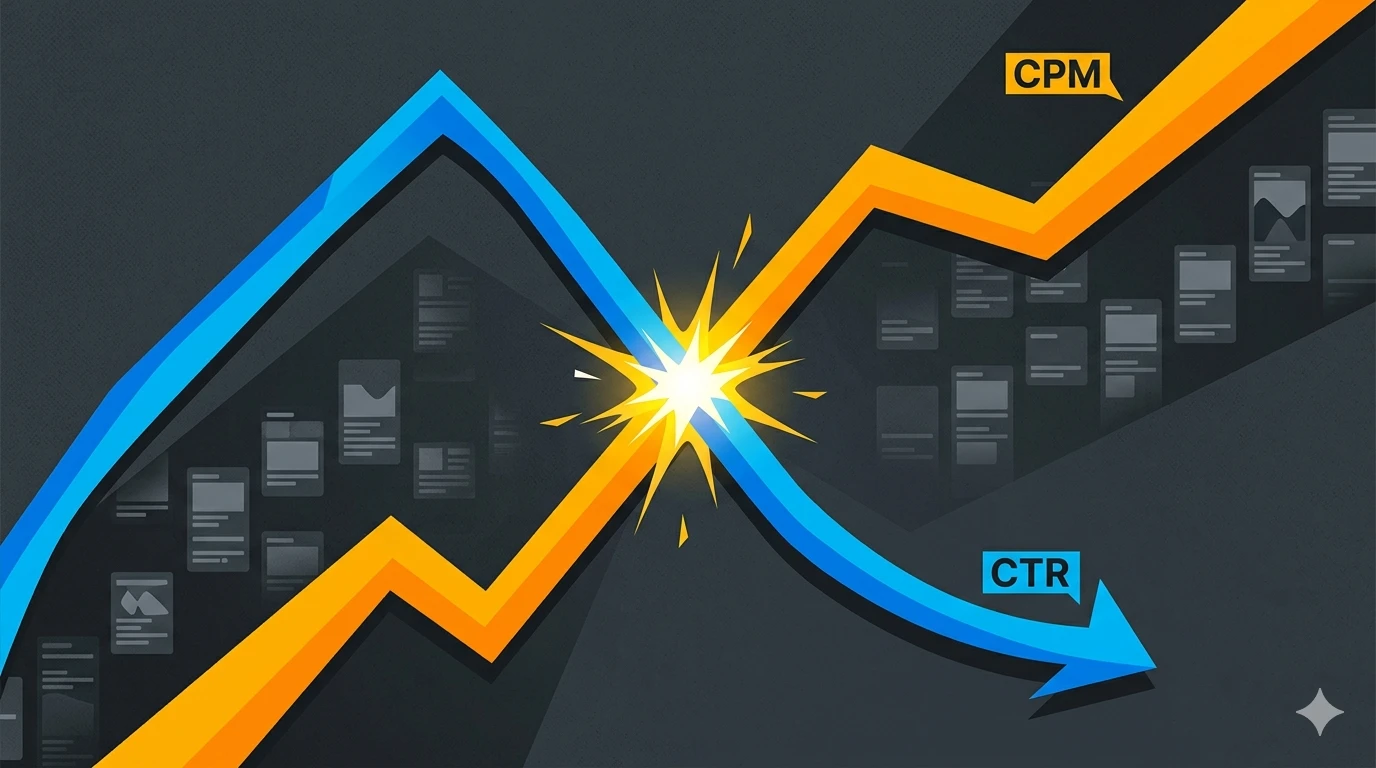
Meta ad creative fatigue is the decline in ad performance that happens when the same audience sees the same creative too many times. It works by desensitizing viewers to a familiar ad, which lowers their click-through rate, prompting Meta's delivery algorithm to charge more per impression to compensate. It's most commonly diagnosed through three metrics moving together: rising frequency, falling click-through rate, and climbing cost per impression, often within two to three weeks of a creative going live.
The mechanics of why this happens
Meta's ad auction doesn't just charge you for reach, it prices your ad based on predicted engagement. When the same audience sees an ad repeatedly, the novelty that drove the original click-through rate disappears, and engagement drops. Meta's delivery system reads that drop as a quality signal and raises your cost per impression to compensate, which is why CPM climbing alongside a falling CTR is the textbook fatigue pattern, rather than CPM rising on its own from broader auction pressure.
The timeline has compressed sharply. Creative fatigue used to set in after six to eight weeks; current data points to two to three weeks for most accounts, with high-spend, narrow-audience campaigns sometimes fatiguing in as little as seven to ten days. The two biggest accelerants are audience size, since a narrow audience reaches saturation faster, and daily budget, since higher spend delivers more impressions per day to the same pool of people.
The early warning signs, in order
Waiting for cost-per-acquisition to confirm fatigue means you've already lost days of wasted spend, since CPA is a lagging indicator. The signals worth watching, roughly in order of how early they appear, are: frequency climbing above 2.5 to 3 for prospecting campaigns without a corresponding lift in conversions; click-through rate dropping 10% over seven days, with a 20% drop over fourteen days signaling a more serious problem; cost per mille rising 15 to 25% over two weeks without any targeting changes; and a shift in comment sentiment, where organic engagement drops or comments start mentioning having seen the ad repeatedly.
The most reliable compound signal is CPM staying flat while CTR drops. A rising CPM alone could just be seasonal auction pressure. CPM holding steady while CTR falls means the auction itself hasn't gotten more competitive, your specific creative has simply stopped working for that audience.
Why most brands under-produce variations
This is the part of the problem that's operational, not strategic. Most D2C brands ship two to four new creatives a month, far below the volume needed to outrun fatigue on a scaled account. For comparison, an analysis across more than 200 DTC accounts found that brands producing 30 or more new creatives a month scale three times faster than brands producing fewer than 10. For Indian D2C brands specifically, a healthy testing benchmark for scaling toward meaningful spend looks like roughly 20 to 25 video creatives and 10 to 12 static creatives a month, a volume most internal teams and single-agency relationships simply aren't built to sustain.
The reason this gap exists isn't a lack of understanding that more creative helps. It's that producing 20-plus video variants a month through a traditional shoot-and-edit process, or even through individual freelance creator bookings, requires either a large budget or a logistics operation most D2C teams don't have the headcount for. Meta's own data has found that creative quality accounts for roughly 56% of a campaign's conversion outcome, more than targeting, bid strategy, and placement combined, which means the production bottleneck is also the single biggest lever most brands are leaving unused.
Why AI UGC is an operationally viable fix
The honest case for AI UGC here isn't that it produces a better individual video than a skilled human creator. It's that it removes the volume constraint entirely. Once a script and character pipeline is set up, producing the fifteenth variant of a hook costs roughly the same as producing the third, which fundamentally changes the math on whether a brand can sustain 20-plus creatives a month without scaling headcount or creator spend proportionally.
This matters more in India specifically because of what's happening to the underlying cost of inaction. Meta CPMs in India have risen roughly 40 to 60% since 2023, according to upGrowth's 2026 D2C Performance Marketing Playbook, which means a brand that isn't refreshing creative fast enough isn't just losing performance to fatigue, it's losing performance to fatigue inside an auction that's getting more expensive at the same time.
Where it works
- Brands already spending enough on Meta that a 56% conversion lever tied to creative quality is worth solving operationally, not just acknowledging
- Accounts running narrow or high-frequency audiences, where fatigue arrives fastest and most predictably
- Teams that have validated a winning angle and need many variations of it rather than entirely new creative concepts every time
Where it doesn't
- Very low-spend accounts where the audience is large enough relative to budget that fatigue isn't yet a binding constraint
- Situations where the underlying issue isn't fatigue but a weak offer or broken landing page, since no amount of fresh creative fixes a conversion problem downstream of the click
- Brands that haven't yet found a winning creative angle to begin with, since volume without a validated concept just produces more noise, not more signal
FAQ
How long does Meta ad creative typically last before fatiguing?
Two to three weeks is the current typical window, down from six to eight weeks a few years ago, with high-spend or narrow-audience campaigns sometimes fatiguing within seven to ten days.
What's the first sign of creative fatigue?
A declining click-through rate on a previously well-performing ad, ideally caught before frequency climbs and before CPM starts rising, since CTR is typically the earliest-moving signal.
How many new creatives should a D2C brand produce monthly?
Benchmarks vary by spend level, but a commonly cited range for Indian D2C brands scaling toward meaningful Meta spend is 20 to 25 video creatives and 10 to 12 static creatives a month.
Does rising CPM always mean creative fatigue?
Not on its own. Rising CPM alongside falling CTR is the fatigue signal. Rising CPM with stable CTR is more likely broader auction pressure unrelated to your specific creative.
Meta ad creative fatigue now sets in within two to three weeks for most accounts, driven by the same audience seeing identical creative until engagement drops and Meta's delivery system charges more to compensate. The clearest warning sign is CPM holding steady while CTR falls. Most D2C brands ship far less creative than the 20 to 30 variants a month needed to stay ahead of this cycle, not because they don't understand the problem, but because traditional production can't sustain that volume without a proportional increase in cost.
If your team is shipping two or three new creatives a month while your account needs twenty, book a free demo with ButterCut to see how a production pipeline built for volume changes that math.
Sources
- Zentric Digital Insights, The Creative Fatigue Playbook
- AdAmigo.ai, Meta Ads Frequency Benchmarks
- Billo, How Many Ad Creatives Do You Need? 2026 Benchmarks for DTC Brands
- Viralgroww, Meta Ads Creative Strategy for D2C Brands
- AdGPT, Ecommerce Ads in 2026: How DTC Brands Beat Creative Fatigue, citing Meta's creative attribution data
- Adtric, citing upGrowth's 2026 D2C Performance Marketing Playbook