



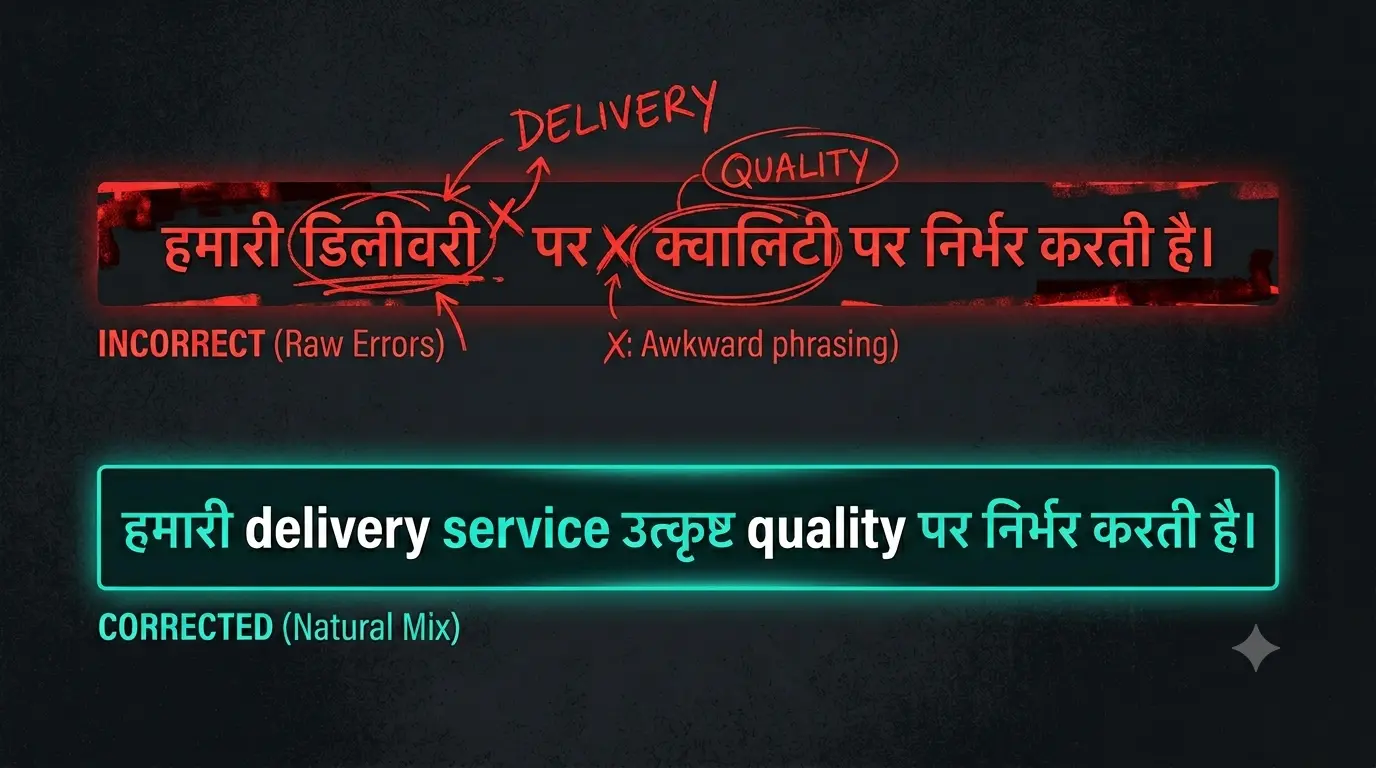
You brief the subtitle vendor. The demo clip sounds acceptable. You approve a test batch, your Hindi speaker reviews it, and the feedback is the same thing every time: it sounds like a machine translation. The words are there, roughly, but the rhythm is wrong, English terms are transliterated into Devanagari where they should stay Roman, and entire sections where the speaker mixed Hindi and English are collapsed into one language or the other. The transcript is technically there. It just doesn't sound like anything a real person said.
This isn't a problem you can fix by finding a better translation tool. It's a structural failure in how most AI subtitle models handle Hinglish, and understanding the mechanism explains why the output is bad and what genuinely fixing it requires.
Hinglish subtitle accuracy is the ability of an AI subtitle system to correctly transcribe, segment, and render content where the speaker alternates between Hindi and English within the same sentence — a pattern called code-switching that is the default communication mode for hundreds of millions of urban Indian speakers, not an edge case. Most AI subtitle models fail on Hinglish because they were built for monolingual speech and treat the language switch as an error to be corrected rather than a linguistic feature to be preserved. The failure manifests as dropped English terms, transliterated English in Devanagari, collapsed code-switching into one language, or hallucinated text at the switch point. Correct Hinglish subtitle handling requires a model specifically trained on mixed-language Indian speech data, not a monolingual Hindi model with English handling bolted on.
The three structural failure mechanisms
When a generic AI subtitle model encounters Hinglish, it fails in one of three specific ways. The failure mode depends on how the model's language detection and transcription components are configured.
Mechanism 1: Language forcing. Standard ASR models are trained on monolingual audio data — they learn Hindi, or they learn English, but they don't learn the space between them. When a Hinglish utterance arrives, the model's language model pushes the transcription toward the dominant language it was trained on, overriding the acoustic signal even when that signal is clearly pointing to a word in the other language. In a Hindi-dominant model, English technical terms embedded mid-sentence get dropped or mangled because the language model's prior is Hindi. The model "decides" the sentence is Hindi and forces the English words into the Hindi vocabulary space, producing Devanagari transliterations of English words that no real speaker would use in that sentence. The inverse happens in English-dominant models: Hindi emotional vocabulary, culturally specific terms, and honorifics get dropped or replaced with English approximations.
Mechanism 2: Switch-point hallucination. At the exact moment a speaker switches language mid-sentence, standard ASR models experience their highest error rate. A benchmark study published in the ACL Anthology identified switch-point word error rate as a meaningfully different and higher metric than overall WER — because the model's uncertainty peaks at the transition, and uncertain models hallucinate. Instead of transcribing what was said, the model generates text that is plausible given the surrounding context but is not what the speaker actually said. For a subtitle on a content platform, this is an accuracy failure that a casual viewer won't catch but a native speaker notices immediately.
Mechanism 3: Sequential language detection routing. Some subtitle pipelines attempt to handle code-switching by routing speech segments to different language models — the Hindi segments go to the Hindi model, the English segments go to the English model. This produces more accurate individual segments than language forcing, but it introduces a new problem: the boundary detection between segments is imprecise, and the join between two model outputs at a switch point is often visually and semantically awkward. The English words are correctly transcribed in Roman script, the Hindi words are correctly transcribed in Devanagari, but the join between them doesn't reflect how a human reader would naturally experience the sentence, and the timing at the switch point is often slightly off.
What wrong output looks like — specific examples
The failure modes above are structural descriptions. Here's what they look like on screen:
A speaker says: "Yaar, is product ki quality bahut acchi hai, but delivery time thoda slow tha." A monolingual Hindi model under language forcing might produce: "यार, इस प्रोडक्ट की क्वालिटी बहुत अच्छी है, बट डिलीवरी टाइम थोडा स्लो था।" — where "but," "delivery," "time," and "slow" are all transliterated into Devanagari rather than kept in Roman script. This is technically a complete transcription, but it's not what the speaker said or how any real Hinglish speaker would write that sentence. A native viewer reads it as machine output immediately.
A speaker says: "Main kal office mein tha, so I couldn't take the call." A language-forcing model might produce: "Main kal office mein tha, so main call nahin utha saka." — replacing "I couldn't take the call" with a Hindi version because the model pushed the sentence toward Hindi-dominant output after the switch point.
A speaker says: "Subscription renew kar lo, otherwise account band ho jaega." A sequential routing system might correctly transcribe "Subscription" in Roman and "renew kar lo, otherwise account band ho jaega" in mixed form — but if the boundary detection between the English and Hindi segments fires at the wrong word, the output might read "Subscription renew" in Roman and then transition to "kar lo, otherwise account band ho jaega" in Devanagari mid-compound, splitting a phrase that a reader processes as a single unit.
The architecture that actually handles it
Standard ASR models fail at Hinglish because of gaps in acoustic modeling, vocabulary, language modeling, and training data. Fixing this requires a ground-up approach, not a patch on an existing English or Hindi model. This is worth taking seriously as a procurement conclusion: there is no version of "choose a better monolingual model" that solves the code-switching problem. The models that handle Hinglish correctly are end-to-end multilingual architectures that process mixed-language audio in a single forward pass — generating mixed-script tokens that reflect how the speaker actually spoke, rather than routing segments to separate models and stitching the outputs.
The practical test for whether a model has this architecture is the mixed-script output test: run a typical piece of Hinglish content through the model and check whether the output naturally mixes Roman script for English words and Devanagari for Hindi words within the same sentence. A genuine Hinglish subtitle pipeline generates mixed-script tokens that reflect how the speaker actually spoke. A model that produces naturally mixed-script output for Hinglish content is processing the code-switching as a linguistic feature. A model that forces everything to one script is treating the code-switching as noise to be cleaned up.
Why the correction cycle doesn't fix this
The correction cycle a content ops team runs after receiving bad Hinglish subtitle output is correcting the symptoms, not the cause. Sending corrections back to a vendor whose underlying model is monolingual doesn't retrain the model for code-switching — it corrects the specific errors in that batch, and the next batch arrives with the same structural failure pattern. A pipeline that actually improves on Hinglish content needs to be incorporating those corrections into the model's training data or fine-tuning — not just applying them to the current file.
For a content platform producing 20 hours of Hinglish subtitle output per month, the difference between a monolingual model that produces 15-20% error rates on code-switched content and a purpose-built Hinglish model that produces 5-8% error rates is approximately 6 to 9 hours of reviewer time per month — the time spent finding and correcting the additional errors. Over a year, that's 72 to 108 hours of reviewer time. That's the cost of the architectural gap between a claimed-Hindi-capable model and a genuinely Hinglish-capable one, expressed in the ops budget rather than in the model specification.
What correct Hinglish subtitle output looks like
The test for correct Hinglish handling is simple and can be run on any content sample before committing to a vendor. Take a 3-minute clip of typical Hinglish content — a social media creator, a reality TV segment, an EdTech presenter, a news anchor doing an interview — and run it through the model. Check three things:
- Mixed-script fidelity: English words in the output should appear in Roman script, Hindi words in Devanagari. Code-switched phrases should maintain their natural register without collapsing to one language.
- Switch-point accuracy: At the moment a speaker switches language mid-sentence, the output should continue accurately in the new language rather than hallucinating a phrase that's plausible-but-wrong.
- Brand name and technical term handling: Product names, app names, and English technical terms should appear in Roman script with consistent spelling, not transliterated into Devanagari or paraphrased into Hindi equivalents.
A model that passes all three on your actual content has genuine Hinglish capability. A model that fails any of them will require correction overhead on every batch of your content, and that overhead won't decrease over time unless the vendor is actively using your corrections to improve the model's Hinglish handling.
Where it works and where it doesn't
Where purpose-built Hinglish subtitle handling makes an operational difference
- OTT platforms with urban Indian content where presenters, dialogue, and narration naturally mix Hindi and English throughout
- EdTech platforms where instructors teach in Hinglish and the subtitle is the learner's primary comprehension support
- Social media and short-form content operations where Hinglish content volume is high and per-minute correction cost adds up across hundreds of clips per month
Where a generic model is sufficient
- Pure Hindi content with no English code-switching, where a monolingual Hindi model can achieve adequate accuracy
- English content targeting Indian audiences, where the language is English throughout and accent handling (not code-switching) is the primary accuracy variable
- One-off low-stakes content where correction overhead is manageable and accuracy standards are lower than for published platform content
FAQ
Why do generic AI subtitle tools list Hindi if they can't handle Hinglish?
Because "supports Hindi" means the tool can process audio in standard Hindi and produce Devanagari output. It doesn't mean the model was trained to handle code-switching between Hindi and English. Supporting a language and handling the way that language is actually spoken in India are different technical achievements, and the feature list reflects the first one, not the second.
Can I get correct Hinglish subtitles by running English transcription first and then translating?
No. Translating English transcription of Hinglish audio into Hindi produces formal Hindi that doesn't reflect the speaker's actual register, loses the code-switching structure entirely, and adds a translation layer that introduces its own errors. The only way to get accurate Hinglish subtitles is to transcribe the Hinglish audio directly with a model capable of processing mixed-language speech — not to route it through two monolingual models in sequence.
How many corrections per minute should I expect on Hinglish content?
With a generic monolingual model: 3 to 5 corrections per minute of Hinglish content is common at a 15-20% error rate. With a purpose-built Hinglish model: 1 or fewer corrections per minute at a 5-8% error rate is achievable on typical urban Indian content. The difference is roughly what determines whether subtitle operations are manageable at volume or become a production bottleneck as content volume grows.
Does the correction improve if I keep sending feedback to the same vendor?
It depends entirely on whether the vendor is using feedback to retrain or fine-tune their model for your specific content. Most generic vendors apply corrections to the current file and don't incorporate them into the model — which means each new batch starts from the same baseline error rate. A pipeline that maintains client-specific correction data and applies it forward produces measurably lower error rates on subsequent batches of similar content.
Hinglish subtitle output sounds like Google Translate because the model that produced it was processing your content the way Google Translate processes it — treating Hindi and English as separate language categories and forcing each word into one or the other, rather than preserving the mixed-language register that the speaker actually used. This is a model architecture problem, not a configuration problem. Choosing a better monolingual model or a cleaner translation pipeline doesn't fix it. What fixes it is a model specifically trained on mixed-language Indian speech data that generates naturally mixed-script output as its default — not as a special mode — and that incorporates corrections from your content into its handling of similar content going forward.
If your Hinglish subtitle output produces a correction cycle that feels like it never improves, ButterCut's subtitle pipeline is built around this specific problem — trained on Indian speech data including code-switched content, maintaining your brand vocabulary and client-specific corrections across batches, and producing mixed-script Hinglish output that reflects how your speakers actually talk. Book a free demo to run it on your own content sample.
Sources
- Shunyalabs, Code-Switching ASR Explained 2026 — standard ASR models fail at Hinglish at acoustic, vocabulary, language modeling, and training data levels; requires ground-up architecture
- Gnani AI, Why Speech Recognition Fails on Hinglish — language model prior forces transcription toward dominant language, deleting secondary language words at switch points
- Gladia, Code Switching in Speech Recognition ASR Guide 2026 — switch-point WER as separate metric; hallucination error rate at transitions
- Deepgram, Hinglish Voice AI 2026 — 600M+ Hinglish speakers; end-to-end multilingual architectures required for code-switched audio
- UMEVO, Why Code-Switching Breaks Most AI Transcription 2026 — phantom hallucinations at switch points; end-to-end single-pass architectures as solution