



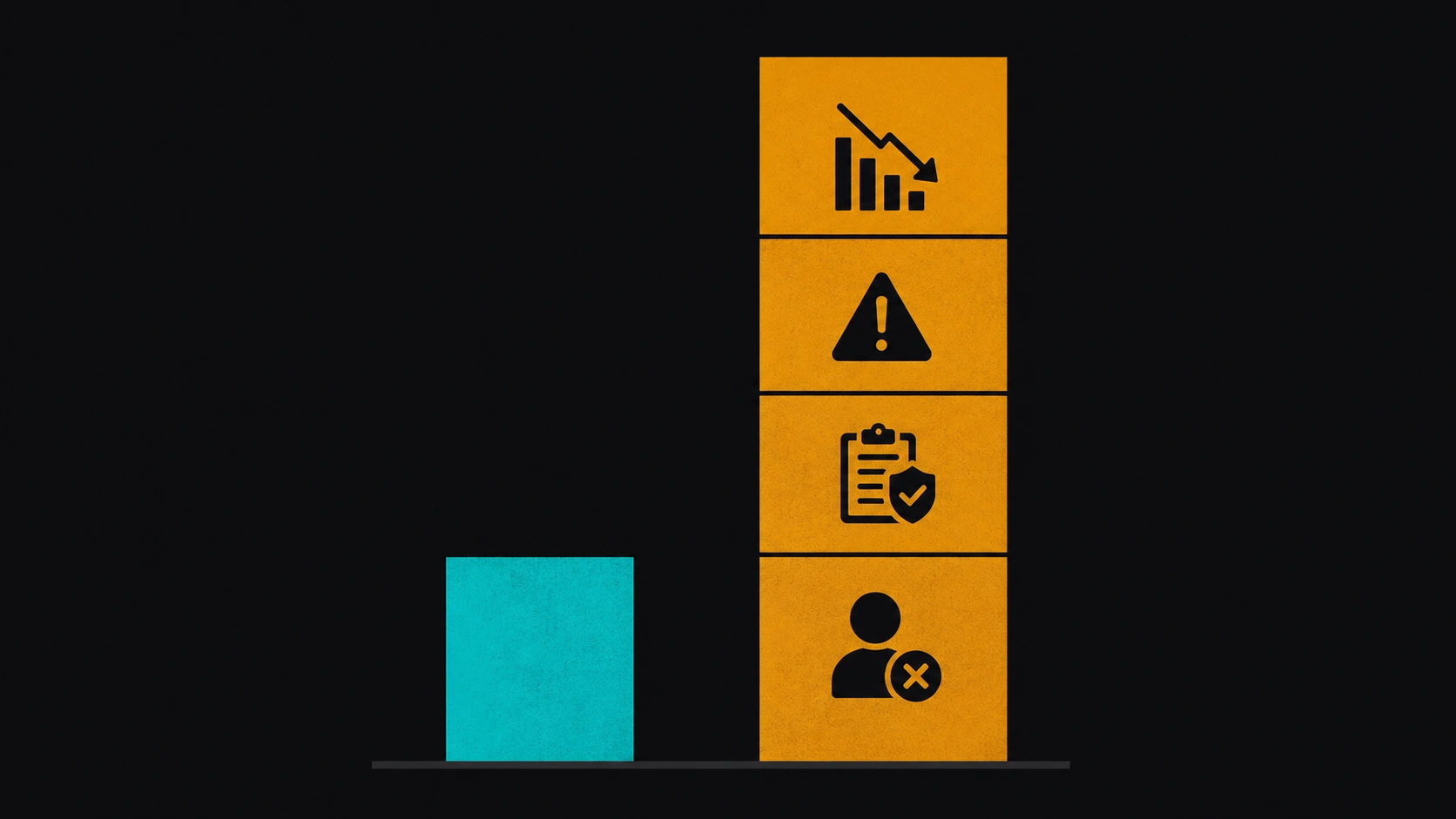
The L&D budget conversation usually focuses on the cost of localising training content — what it costs to add Hindi subtitles or produce regional-language voiceovers. The more important number, and the one that almost never gets calculated, is the cost of not doing it: the productivity loss, error rates, process failures, and attrition that accumulate when a workforce receives training in a language that isn't their primary one.
The hidden cost of English training delivery to a Hindi-speaking workforce is the aggregate of four distinct cost categories that don't appear on the L&D invoice: reduced training effectiveness and the rework that follows, increased error rates from incomplete procedure comprehension, compliance incidents from misunderstood safety or policy content, and slower onboarding that delays new employees reaching full productivity. It is most commonly underestimated in Indian organisations with distributed regional workforces, because the language mismatch is normalised rather than quantified.
Why this cost is invisible
The reason this cost rarely gets calculated is that it doesn't generate its own line item. The safety incident gets attributed to operator error or equipment failure. The process deviation gets attributed to insufficient supervision. The high attrition rate in a regional facility gets attributed to local market conditions. The slow time-to-productivity for new hires gets attributed to the complexity of the role. The possibility that a significant portion of these outcomes traces to training that was delivered in a language the affected employees didn't fully process rarely gets surfaced in the analysis, because the training completion record shows 100% and the assessment pass rate is acceptable.
Completion is not comprehension. Assessment passage in a multiple-choice format where questions can be answered through elimination or guessing is not evidence of the depth of understanding required to change workplace behaviour. The organisations that close this gap are the ones that treat Hindi training video production as an operational requirement rather than an optional enhancement. The gap between these two things is where the hidden cost accumulates.
The four cost categories
Category 1: Reduced training effectiveness and rework
When employees process training content in a non-primary language, they retain less of it. The cognitive load mechanism is well-established: language processing consumes working memory that would otherwise be available for content encoding. An employee attending an English-language training session while mentally translating the content into Hindi is doing two jobs simultaneously, and does both of them less well than they would with a single-language input.
The practical consequence is rework — the additional supervision, retraining, error correction, and performance management that accumulates when training doesn't stick the first time. First-year productivity loss from employees who don't fully absorb onboarding and training content is estimated at 30 to 50% of annual CTC in Indian corporate contexts, according to Taggd's 2026 workforce analysis. Not all of this is attributable to language mismatch, but in organisations where English training is delivered to a predominantly Hindi-speaking regional workforce, language comprehension is a significant contributing factor that's rarely isolated in the analysis.
Category 2: Process errors and quality failures
Procedure-based roles — manufacturing, field service, logistics, healthcare, retail operations — have training content that specifies exactly what to do in a given sequence. When that content is delivered in English to a workforce that thinks in Hindi or a regional language, the precision of the procedure is at risk. An employee who understands the general idea of a process but misses a specific step or condition because it was expressed in unfamiliar language will perform an approximation of the correct procedure rather than the procedure itself.
The cost of process errors compounds: rework on the immediate output, waste of materials, supervisor time on correction, and in quality-controlled environments, the cost of non-conformance reports, customer complaints, or product recalls. None of these get attributed to "training language mismatch" in the root cause analysis, but the relationship is real and the cost is measurable if the right question gets asked.
Category 3: Compliance incidents and legal liability
Compliance training — safety procedures, POSH (Prevention of Sexual Harassment), data protection, anti-bribery, financial controls — carries higher consequence for comprehension failure than process training. A safety procedure misunderstood through language barrier can result in an injury. A POSH policy that employees understand abstractly but not specifically enough to apply creates incidents and litigation exposure. A data protection obligation that employees acknowledge completing training on but cannot demonstrate understanding of creates regulatory liability after a breach.
Workplace injury cases involving language barriers settle for 2 to 3 times higher amounts than comparable cases without a language barrier dimension, because the employer's failure to ensure comprehension weakens the legal defence. The annual cost of compliance incidents to Indian organisations — across safety, HR, and regulatory dimensions — is large and widely distributed, and the proportion attributable to training language mismatch is not typically calculated. Hindi-language subtitle production for compliance training is one of the cheaper insurance policies available against this category of cost.
Category 4: Slower onboarding and attrition
New employee onboarding that's delivered in English to a Hindi-primary workforce takes longer to produce the intended output — not because the employees are less capable, but because the language processing overhead slows down the absorption of role-specific knowledge. Time-to-productivity extends. The new hire starts asking questions that the training should have already answered, because they didn't retain the English-language answer. Supervisors spend more time re-explaining concepts that were covered in the training. This is a direct labour cost, and it's measurable as the additional supervision hours per new hire multiplied by the supervisor's cost per hour.
Attrition from early-career employees who find the English-language training environment alienating or who feel they're being set up to fail is harder to quantify but consistently mentioned in exit interviews from regional Indian facilities. The cost of replacing a departed employee is typically cited at 50 to 200% of annual salary. Language mismatch in onboarding is rarely identified as a contributing factor, but in organisations where regional employees consistently have higher early attrition than English-primary employees in the same role, the language dimension is worth investigating.
Building the actual cost comparison
The decision framework for whether to invest in Hindi training video subtitles should compare two numbers: the cost of producing subtitles for the training library, and the estimated annual cost of the four categories above attributable to language mismatch.
For a typical Indian corporate training library — 100 to 300 hours of video content, delivered to 500 or more regional employees — the subtitle production cost for Hindi is a one-time project cost of roughly ₹30 to ₹90 lakh for a managed service, plus ongoing production costs for new content at roughly ₹500 to ₹1,200 per video minute. The annual cost of the hidden categories — even conservatively estimated at 5% of the productivity loss, error, compliance, and attrition costs that language mismatch contributes to — almost always exceeds this figure at scale.
This calculation is not usually done, because the hidden costs are attributed to other causes. The right diagnostic for an L&D team is to compare key performance metrics — process error rates, compliance incident rates, onboarding time-to-productivity, early attrition — between workforce segments who received training in English only and workforce segments who received the same training with Hindi subtitles. If the metrics diverge in the direction the hypothesis predicts, the case for the investment is made from internal data rather than from an industry benchmark.
Where it works and where it doesn't
Where the ROI case is strongest
- High-density regional facilities where a large proportion of the workforce is Hindi-primary and the training library is entirely English-language
- Procedure-intensive roles in manufacturing, field service, or logistics where process errors have direct cost consequences
- Safety and compliance training, where the legal and incident cost of comprehension failure exceeds the subtitle production cost by a wide margin
- High-attrition roles where onboarding quality directly affects whether a new hire reaches full productivity before leaving
Where the ROI case is weaker
- Workforces where English is genuinely the primary professional language and the language gap is small
- Training content for roles where procedure errors have low cost consequences and supervision can catch mistakes before they compound
- Very small workforce sizes where the fixed cost of subtitle production doesn't amortise across enough employee-hours of training
FAQ
How do I calculate the cost of language mismatch in my organisation's training?
Compare performance metrics — error rates, compliance incidents, onboarding time, early attrition — between workforce segments receiving English-only training and segments who received the same training with Hindi subtitles. If you haven't yet introduced subtitles, run a pilot with one function or facility and measure the delta. The numbers are in your existing HR and operational data; the question is whether the analysis has been run.
Is the hidden cost of English training significant enough to justify Hindi subtitle production?
For most Indian organisations with 200 or more regional employees receiving procedure or compliance training, the cost categories above — even conservatively estimated — exceed the subtitle production cost within the first year. The comparison rarely gets done because the hidden costs aren't attributed to their root cause, but when the full picture is built, the economics of subtitle production are typically straightforward.
Should we subtitle training or produce full Hindi voiceovers?
Both work. Subtitles are faster to produce and cheaper, preserve the original audio (which may include expert voices or brand tone you want to retain), and work for employees who are functional in English but more comfortable in Hindi. Full voiceover is more thorough, particularly for low-literacy workforce segments who find reading subtitles while watching video difficult. For most corporate training contexts, subtitles are the right starting point; voiceover is the right investment for safety-critical content with a low-literacy audience.
What's the cost per employee-hour of Hindi subtitle production?
At a managed service rate of ₹500 to ₹1,200 per video minute, subtitling one hour of training content costs roughly ₹30,000 to ₹72,000. If that content is delivered to 500 employees, the subtitle cost per employee-hour of training is ₹60 to ₹144. The question is whether the comprehension improvement that Hindi subtitles produce is worth ₹60 to ₹144 per employee-hour of training — relative to the four hidden cost categories described above, the answer is almost always yes.
The cost of delivering English training to a Hindi-speaking workforce doesn't appear on the L&D invoice. It appears as process errors that get attributed to operator failure, compliance incidents that get attributed to individual negligence, onboarding delays that get attributed to role complexity, and attrition that gets attributed to market conditions. The subtitle production cost is visible and budgeted. The language mismatch cost is invisible and unbudgeted. Building the full cost picture — which requires comparing workforce performance metrics between English-only and subtitled training cohorts — consistently shows that the investment in Hindi subtitle production costs less than the problem it solves.
If your organisation has a regional workforce receiving English training and you want to see the cost comparison built from your actual workforce data, ButterCut can help you think through the analysis — and produce the Hindi subtitle library that closes the gap. Book a free demo to start with a sample from your training content.
Sources
- Taggd, Workforce Reskilling India 2026 — first-year productivity loss 30-50% of CTC; digital upskilling ₹15,000-₹25,000/employee annually
- Coggno, Multi-Language Compliance Training — workplace injury cases with language barriers settle 2-3x higher; 25% of job-related accidents involve language barriers (OSHA)
- Articulate, Why Translate Compliance Training — brain processes native language faster; compliance breach consequences
- Fiveable, Cognitive Load in Language Processing — working memory consumed by second-language processing
- Circle Translations, Subtitling Services for E-Learning — $5-$15/min professional subtitling range