



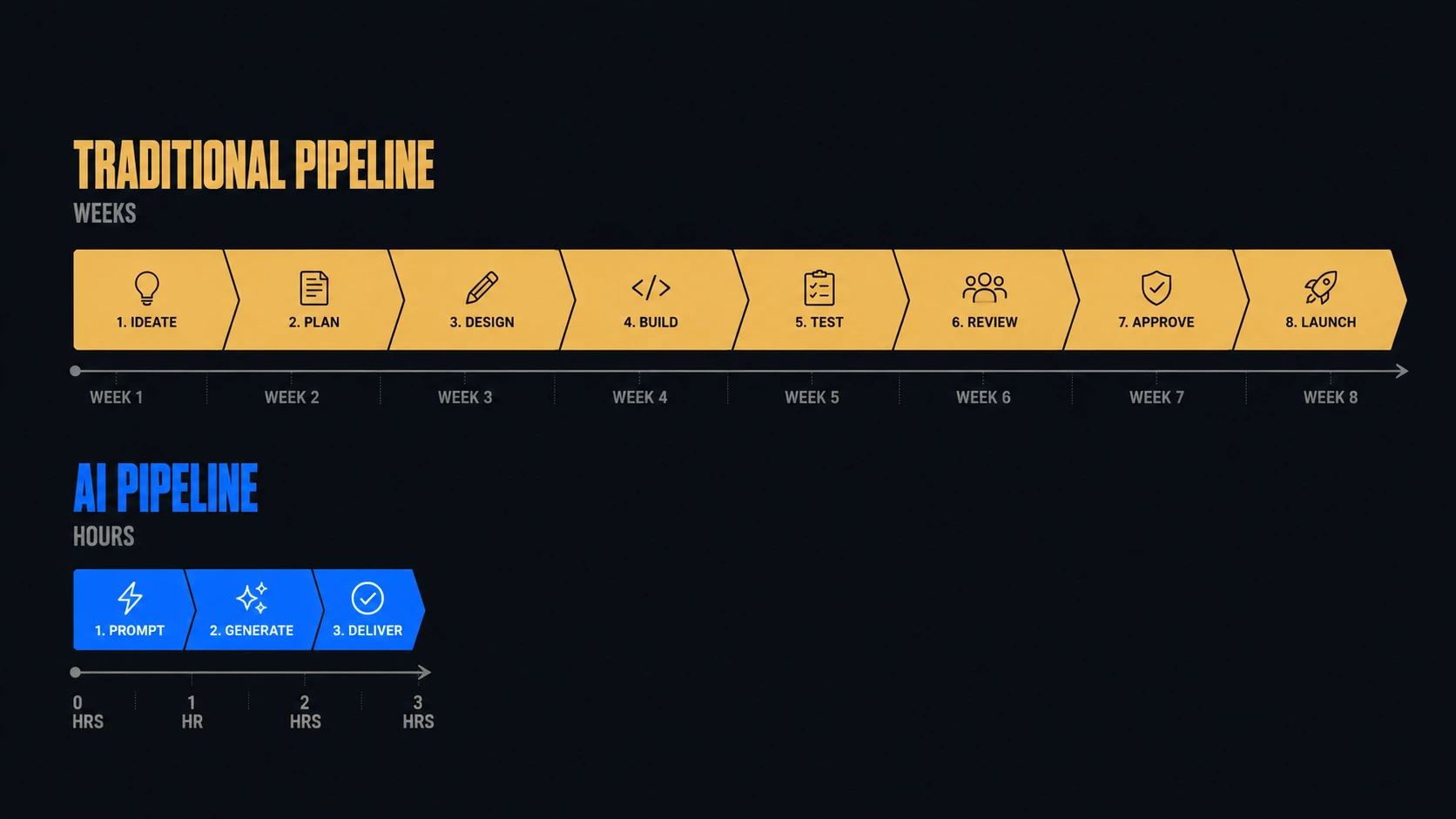
A post-production supervisor managing subtitle delivery for a film going to OTT knows the timeline problem intimately. Source transcript, translation queue, translation delivery, QA pass, format conversion, platform-specific delivery check, redelivery if something fails. In a traditional agency-based pipeline, that sequence takes three to five weeks for a feature with six or eight language tracks. Platforms that want simultaneous multi-language availability at launch don't have three to five weeks. The math doesn't work.
Film and TV subtitle post-production is the process of producing, quality-reviewing, and delivering timed subtitle files for a finished video production across one or more languages, ready for platform ingestion. It works by converting the final locked audio into a source transcript, translating and re-timing per target language, completing a QA pass, and outputting in the delivery format each distribution platform requires. It is most commonly managed by post-production supervisors and localization leads working on OTT originals, film releases, episodic television, and long-form documentary content destined for multi-language distribution.
The traditional subtitle pipeline and where the time goes
The timeline problem in traditional subtitle post-production is structural, not circumstantial. Each stage is sequential, each handoff creates a waiting period, and the number of language tracks multiplies the total throughput time rather than running in true parallel.
Source transcription produces the master transcript from the locked audio. For a 90-minute feature with complex audio — dialogue overlaps, background noise, music — a careful human transcription pass can take 8 to 12 hours. AI-assisted transcription compresses this to minutes on clean audio, with a human review pass for problem sections.
Translation queue is typically the longest stage. In a freelancer-network agency model, translations for six languages don't run simultaneously — they run as the relevant translators are available. A two-week translation window for six language tracks isn't unusual in a standard post-production subtitling engagement. The underlying per-language translation time is shorter than that, but the queue management adds waiting time that the per-word rate doesn't reflect.
Per-language re-timing adjusts each translated subtitle file for the target language's reading speed and character length. A Hindi translation of English dialogue runs longer in Devanagari script and needs more display time per subtitle event. This stage happens after translation and before QA — it's sequential, not parallel.
QA pass is a native-speaker review of each language version. This is the stage most commonly compressed under deadline pressure, and also the stage where the errors most visible to viewers are caught. Terminology inconsistency across episodes, mistranslated proper nouns, cultural adaptation failures — all of these show up here and nowhere else in the pipeline.
Format conversion and platform delivery check converts the approved subtitle files into each platform's required format — TTML for Netflix, SRT for most streaming CMS platforms, EBU-STL for broadcast — and runs a technical preflight to confirm the files will pass ingestion. A file rejected at platform ingestion triggers a redelivery cycle that can add days to an already-tight schedule.
For a feature release in six languages, these five stages running sequentially through a traditional agency pipeline produce a total timeline of three to five weeks. According to Vitrina AI's analysis of post-production workflows across more than 140,000 film and TV companies, AI integration delivers 25 to 40 day timeline compression on features and 50 to 70% localization savings — figures that reflect exactly this pipeline restructuring.
Where AI compresses each stage
The compression doesn't happen uniformly across all stages. Understanding where AI creates the most time savings helps production teams prioritise which stages to restructure first.
Transcription: this is the stage where AI delivers the most dramatic speed improvement. Modern AI transcription for clean audio — broadcast-quality recording without significant background noise — runs at speeds that make human-only transcription economically unjustifiable for first-pass work. The human review pass that catches technical vocabulary errors, proper noun misidentification, and audio-specific problems takes a fraction of the time that full human transcription would. For Indic language content, AI transcription accuracy on Hindi, Tamil, Telugu, and other regional languages has improved substantially through 2025-2026, though it remains below English-language accuracy for code-switched content and regional accents.
Translation: AI translation for subtitle work has matured significantly and is now "deployable for streaming at scale" for standard language pairs, according to Vitrina's assessment of post-production AI adoption. The important qualifier is "standard language pairs" — AI translation models trained primarily on European and major Asian languages perform better than models running Indic language pairs on limited training data. For productions requiring Hindi, Tamil, or Telugu subtitle tracks, the quality ceiling of AI-first translation is meaningfully lower than for English-to-Spanish or English-to-French pairs, which is why human translator review remains standard in Indic language post-production pipelines even when AI handles the first draft.
Re-timing: AI re-timing tools that understand the reading-speed and character-length constraints of different scripts can compress what was a manual frame-by-frame timing adjustment into an automated pass with targeted human correction. For productions with Indic language tracks, the re-timing adjustment is material — Devanagari and Tamil script run longer than Roman text and require more significant display-time adjustment than European language translations.
QA: this is the stage AI assists but cannot replace. Automated QC tools check for format compliance, reading speed violations, timing overlaps, and technical errors — the machine-checkable portion of the QA checklist. Native-speaker review catches what automated tools miss: unnatural phrasing, register mismatches, cultural adaptation failures, and consistency errors that require a human who understands both the content and the target language. In a well-designed AI-native subtitle pipeline, QC automation handles the mechanical checks, freeing native-speaker reviewers to focus on editorial judgment rather than format compliance.
Format delivery: platform-specific format conversion and delivery preflight are well-suited to automation. Netflix's TTML requirements, Amazon's format specifications, and standard SRT export can all be handled by automated delivery tools that run validation checks before submission. This stage, which was a manual process in traditional pipelines, adds little time in an AI-native workflow.
What the compressed timeline looks like in practice
For a production team restructuring its subtitle pipeline around AI-native tools with human review layered in, the same five stages that took three to five weeks in a traditional pipeline compress to a different shape entirely. AI transcription and first-draft translation happen in hours, not days. Re-timing runs as an automated pass overnight. QA focuses human reviewer time on the editorial decisions rather than the mechanical checks. Format delivery is automated.
The result for a feature in six language tracks is a subtitle post-production pipeline of 24 to 72 hours for standard language pairs with clean audio, compared to the traditional three to five weeks. For productions with Indic language subtitle tracks, the timeline compression is achievable but requires a pipeline that has specifically addressed Indic language accuracy — not a global pipeline with Indic language options added to a European-trained architecture.
What human QA still owns
The compression shouldn't be misread as full automation. The stages AI accelerates most dramatically — transcription, first-draft translation, format conversion — are not the stages where the most consequential errors occur. The stages where AI assistance has the lowest ceiling — native-speaker editorial review, cultural adaptation judgment, code-switching accuracy in Indic language content — remain human-dependent.
For post-production teams evaluating AI-native subtitle vendors, the right question is not "how fast can you deliver?" It's "what does your human QA layer cover, in which specific languages, performed by whom?" A pipeline that delivers a 90-minute feature in 24 hours by skipping native-speaker QA has not compressed the timeline — it has transferred the QA burden to the production team's internal review, which often discovers errors too late to fix without full redelivery.
Where it works and where it doesn't
Where it works
- OTT originals requiring simultaneous multi-language subtitle delivery at platform-standard quality, where the traditional pipeline timeline is incompatible with the release window
- Episodic series where consistency across episodes and seasons requires a maintained glossary and style guide, which AI pipelines can carry across every episode rather than rebuilding per engagement
- Indic language subtitle production for Indian OTT platforms distributing nationally or internationally, where the combination of timeline pressure and language-specific accuracy requirements is most acute
Where it doesn't
- Content with unusually complex audio — multi-speaker scenes without clear separation, heavy background music, significant acoustic treatment — where AI transcription accuracy degrades and human transcription time doesn't compress proportionally
- Productions requiring broadcast-standard closed captions for SDH alongside standard subtitle tracks, where the additional deliverable scope needs to be budgeted into the timeline separately
- Highly specialised technical content — scientific documentaries, legal proceedings — where AI translation without specialist human review produces accuracy failures on domain-specific vocabulary
FAQ
How long does subtitle post-production take for a feature film today?
In a traditional agency-based pipeline, three to five weeks for a feature with six or eight language tracks is typical. In an AI-native pipeline with human QA, 24 to 72 hours is achievable for clean audio in standard language pairs. Indic language tracks and complex audio extend both timelines, but the proportional compression holds.
Does AI post-production subtitling meet Netflix's quality standards?
It depends on the pipeline. Netflix's subtitle delivery requires TTML format with specific technical parameters, conformance to per-language timed text style guides, and SDH as a separate deliverable. AI tools handle format generation and technical compliance well. Native-speaker QA conforming to Netflix's per-language style guides requires human review — this isn't a stage that can be automated without quality consequences on premium content.
How does subtitle pipeline compression work for Indic language tracks?
AI transcription on Indic language audio and AI translation into Indic languages both improve substantially when the pipeline was trained on Indian speech data rather than adapted from a Western-trained model. The compression timeline for Indic tracks is achievable with a purpose-built Indic pipeline; it's less achievable with a generic global pipeline that lists Hindi as one of 50 supported languages.
What's the role of human QA in an AI subtitle pipeline?
Human QA in an AI-native pipeline focuses on editorial decisions rather than mechanical checks. Automated QC handles format compliance, timing validation, and reading-speed verification. Native-speaker reviewers handle phrasing naturalness, cultural adaptation accuracy, code-switching correctness, and terminology consistency — the decisions that require understanding the language and the content, not just checking the file against a specification.
Traditional film and TV subtitle post-production pipelines take three to five weeks because every stage is sequential and every language track multiplies the waiting time. AI-native pipelines compress the same scope to 24 to 72 hours by running transcription, first-draft translation, and format conversion as fast automated passes, leaving human QA to focus on the editorial decisions that automation can't make. The compression is real, documented at 25 to 40 days on features, and commercially deployed at scale. For Indic language tracks specifically, achieving the same compression requires a pipeline that was built for Indian content — not a global pipeline with Indic language options added to a model trained on European data.
If your post-production team is managing subtitle delivery across Indian languages and the current timeline is incompatible with your release schedule, ButterCut is built for exactly this — Indic language subtitle production with native-speaker QA at post-production speeds. Book a free demo to run the timeline comparison against your next project.
Sources
- Vitrina AI, AI in Film Making: The 2026 Strategic Production Framework — 25-40 day timeline compression; 50-70% localization savings
- Vitrina AI, AI's Game-Changing Role in Post-Production — automated subtitling and closed-caption generation now standard
- Vitrina AI, How AI Is Revolutionizing Film Post-Production in 2026 — streaming platforms deploying AI subtitling pipelines at scale
- Studies in Media and Communication Vol. 14, No. 2, June 2026 — Netflix use of GPT-based models for auto-generating subtitles
- IntlPull, Subtitle Localization Complete Guide 2026 — AI-assisted first draft, human cultural adaptation workflow
- TV Technology, Telestream AI capabilities 2026 — automated QC integration, subtitle alignment checks in production pipelines