



"Do AI UGC ads actually convert, or are we just paying less for worse creative?" is the question every media buyer asks before greenlighting a test budget. The honest answer requires separating two different claims that get conflated constantly: does AI UGC perform on click and conversion metrics, and do consumers trust it once they realize what they're looking at.
AI UGC ads convert when the script and production quality are strong, performing comparably to or occasionally better than human-made ads on click-through rate and cost-per-acquisition in independent field studies. They work by leveraging the same testimonial-style format that already converts well, regardless of who or what delivers it. They convert best for performance prospecting and hook testing, and less reliably for trust-sensitive categories where audiences actively look for signs of authenticity.
What the independent data actually shows
The most rigorous study available on this question comes from Ipsos, working with faculty from Syracuse University's Newhouse School, which tested 20 ads across 10 brands with 3,000 US respondents, pairing pre-existing human-made ads with AI-generated counterparts built from the same creative brief. Human-made ads outperformed their AI counterparts, but the gap was narrow, and consumers largely couldn't tell the difference: only 13% of viewers who saw an AI-generated ad were even somewhat confident it was AI-made, the same share who incorrectly suspected a human-made ad of being AI.
A separate large-scale field study by Taboola, conducted with researchers from Columbia, Harvard, the Technical University of Munich, and Carnegie Mellon, analyzed more than 500 million ad impressions and 3 million clicks on Taboola's own platform. In raw data, AI-generated ads actually saw a slightly higher average click-through rate, 0.76% versus 0.65% for human-made ads, though the two performed comparably once the tightest statistical controls were applied. The same study found something specific and useful: AI ads that didn't visually "look like AI" achieved the highest engagement of any group tested, outperforming both human ads and AI ads that read as obviously synthetic.
The catch: performance breaks when the AI is detectable
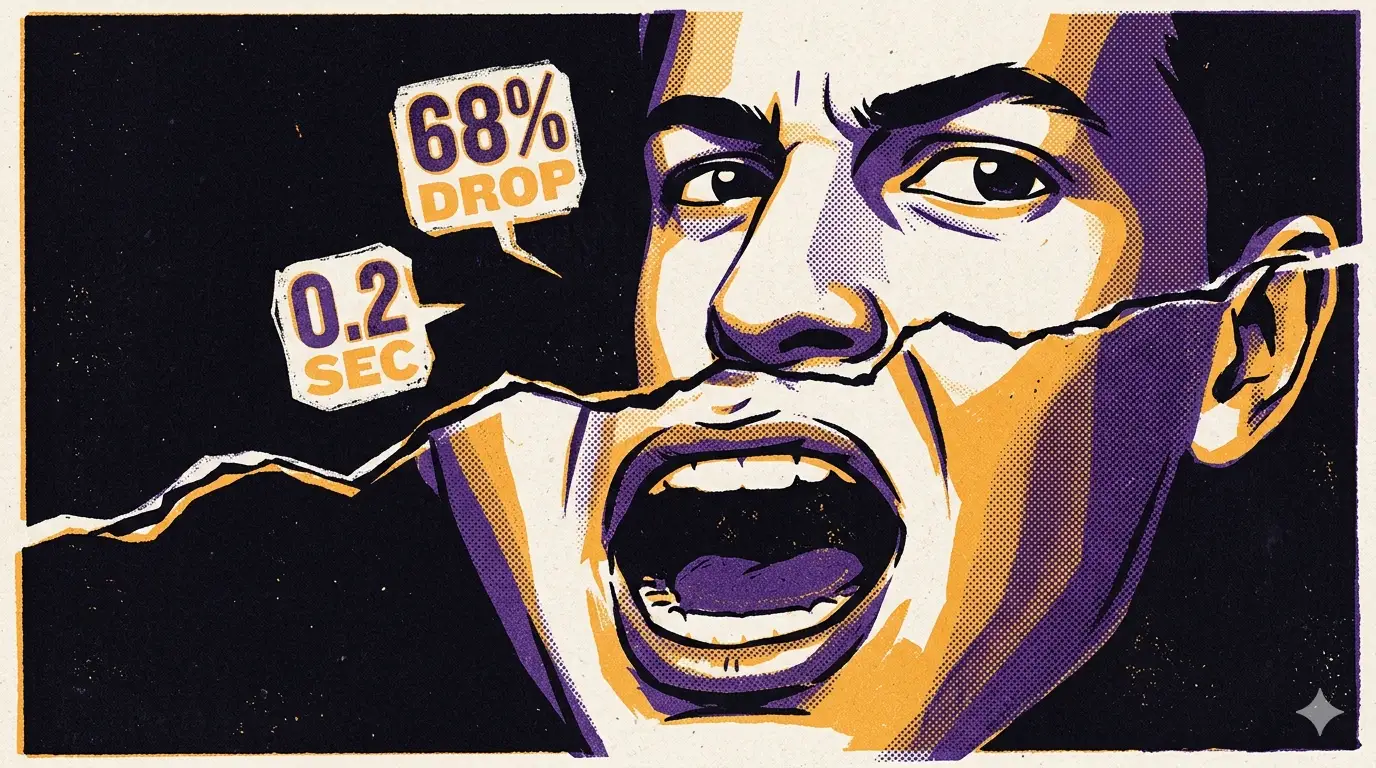
One field analysis found that a single avatar with a 0.2-second lip-sync delay on a key word saw a 68% drop in click-through rate compared to its human baseline, even though viewers couldn't consciously articulate what felt wrong. The same source found that a custom AI avatar built from real footage of an actual team member, with the same imperfect framing and energy as the source video rather than polished studio production, reached 87% of the original human creative's conversion rate.
This is the pattern that matters more than any single headline statistic: AI UGC doesn't convert because it's AI, and it doesn't underperform because it's AI either. It converts when production quality clears the threshold where a viewer's brain stops actively flagging "something is off," and the threshold is unforgiving. A single mistimed word can cost more than half the ad's effectiveness.
The trust gap that performance data doesn't capture
Separately from click and conversion metrics, broader survey data shows real consumer discomfort with AI in advertising as a category. Basis's industry survey found 65% of US adults somewhat or very uncomfortable with the practice of using generative AI to create ads, and a meaningful gap between advertiser optimism, 77% positive, and consumer sentiment, only 38% positive. This matters because it's a different metric than CTR: a viewer can click on an ad and still feel slightly worse about the brand once they realize it was AI-made, an effect that won't show up in a single campaign's performance numbers but can matter for long-term brand perception.
Disclosure complicates this further rather than resolving it cleanly. Some research finds disclosure increases trust when done well, while other studies find AI disclosure labels measurably reduce positive attitudes toward the ad in the moment. For Indian brands, this tension now has a regulatory dimension too: ASCI's May 2026 draft guidelines move toward mandatory, prominent disclosure for AI-generated advertising content, which means the trust question is becoming a compliance question as well as a brand one.
Where it works
- Performance prospecting and hook testing, where the goal is finding a winning angle across many variants quickly
- Categories where the message itself, not the messenger's perceived authenticity, drives the decision: apps, simple consumables, feature-led products
- Campaigns where production quality can be tightly controlled, since the conversion advantage disappears the moment the AI becomes detectable
Where it doesn't
- Trust-sensitive verticals like health claims, finance, or before-and-after transformation content, where audiences actively scrutinize for authenticity
- Brand-building campaigns optimizing for long-term sentiment rather than immediate click performance
- Any execution where script or lip-sync quality can't be tightly controlled, since a single technical flaw can erase the entire performance advantage
FAQ
Do AI UGC ads convert as well as human-made ads?
Independent studies show the performance gap is narrow to nonexistent when production quality is high. The Ipsos/Syracuse study found human ads slightly ahead; the Taboola field study found AI ads slightly ahead in raw CTR, with both effectively comparable under tighter controls.
Can people tell when an ad is AI-generated?
Usually not with confidence. The Ipsos/Syracuse study found only 13% of viewers were even somewhat confident an AI-generated ad was AI-made, no higher than the false-positive rate for human-made ads.
Does AI disclosure hurt ad performance?
The research is mixed. Some studies show disclosure can increase trust when framed well; others find it measurably reduces positive attitudes toward the specific ad. Regardless of the performance debate, disclosure is moving toward a regulatory requirement in markets including India.
What's the single biggest factor in whether an AI UGC ad converts?
Production quality clearing the detectability threshold. A 0.2-second lip-sync error has been measured to cause a 68% drop in click-through rate, far outweighing any inherent advantage or disadvantage of the AI format itself.
AI UGC ads convert at rates comparable to human-made ads when production quality is high enough that viewers don't consciously register the content as artificial, according to independent studies from Ipsos, Syracuse University, Taboola, and four research universities. The format's biggest risk isn't underperformance; it's a sharp performance cliff the moment a viewer detects the AI, where even small technical flaws can cut click-through rate by more than half. The honest verdict: AI UGC converts best for performance prospecting and hook testing, not for trust-sensitive categories where audiences are actively looking for signs of authenticity.
If you've tested a generic AI avatar tool and seen weak results, the problem is more likely production quality than the format itself. Book a free demo with ButterCut to see what a pipeline built to clear that detectability threshold for Indian audiences actually looks like.
Sources
- Phys.org, reporting on the Ipsos / Syracuse University Newhouse School study
- Taboola, with Columbia, Harvard, Technical University of Munich, and Carnegie Mellon University
- RevenueCat, How to Scale AI-Generated Ads Without Losing Trust
- Basis, Navigating Consumer Skepticism Around AI in Advertising
- Mondaq / Khaitan & Co, ASCI's Draft AI Disclosure Guidelines