



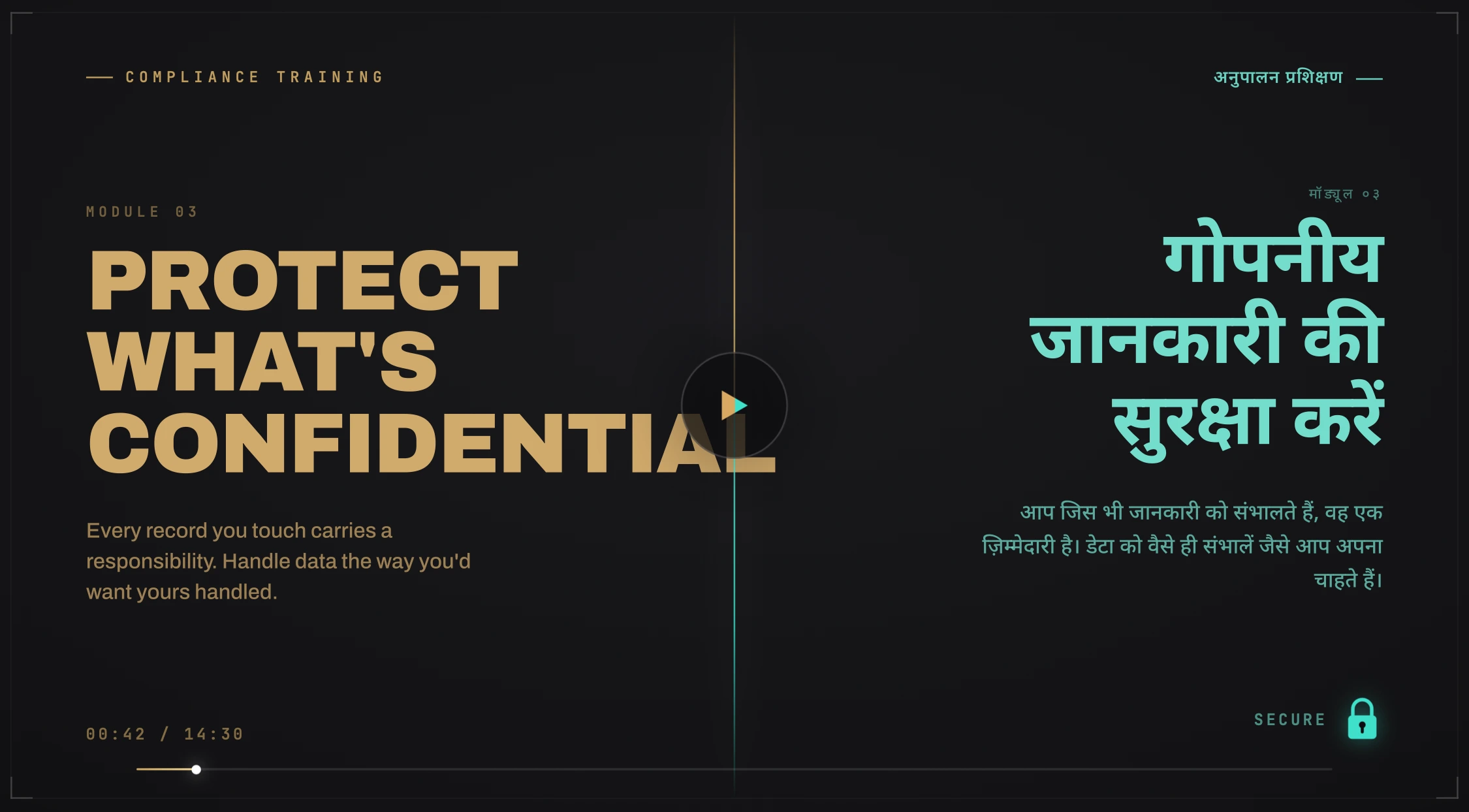
Most L&D teams think about multilingual compliance training as an accessibility improvement. Regulators and courts think about it differently: training that employees cannot understand is treated as no training at all. The distinction matters because it shifts the framing from "nice to have" to "the minimum required to have a defensible compliance record."
Multilingual compliance training video is the delivery of mandatory workplace compliance content — safety procedures, anti-harassment policies, data protection obligations, code of conduct — in the language each employee group actually understands, rather than in a single corporate language that some employees understand partially. It works by either translating the full training content into each target language or, more commonly, adding native-language subtitles to English-language video content so employees receive the spoken English narration with readable support in their primary language. It is most commonly required by organisations with distributed workforces across multiple Indian states, where Hindi and regional languages are the primary workplace communication language for a significant percentage of employees.
The liability angle most Indian organisations haven't confronted
The legal principle is consistent across jurisdictions and increasingly enforced: employees must receive compliance training in a language they genuinely understand, not merely in the language the employer finds convenient. OSHA's guidance states explicitly that training delivered in a language employees don't understand is a failure to train, which results in citations, penalties, and increased liability. Under anti-bribery frameworks including the FCPA and UK Bribery Act, companies must demonstrate effective anti-corruption training — not just proof of delivery. If training was delivered only in a non-native language, regulators treat the compliance programme as inadequate, weakening legal defences during investigations.
For Indian organisations, the practical exposure is real. A manufacturing plant in Rajasthan where safety training is delivered in English to a workforce that communicates primarily in Hindi is not protected by the existence of the training module, if employees cannot demonstrate that they understood it. The completion record in the LMS is evidence of delivery, not evidence of comprehension. When an incident occurs, the gap between those two things is exactly where legal exposure lives.
Language barriers are estimated to contribute to roughly 25% of job-related accidents in multilingual workplace environments. Compliance breaches — including safety incidents, data protection failures, and policy violations — carry consequences including legal liability, financial penalties, and reputational damage. The cost of multilingual subtitle production for a compliance training library is small relative to a single serious incident settlement. It is rarely framed this way in L&D budget conversations, but it should be.
The specific failure modes for English-only compliance delivery in India
English-only compliance training delivered to a regional-language workforce in India fails in three distinct ways, and each failure mode has a different fix.
Vocabulary failure. Compliance content is vocabulary-dense in ways that general business English is not. Terms like "conflict of interest," "material non-public information," "vicarious liability," "tortious act," and "data subject rights" have precise legal meanings that don't translate intuitively even for employees who are functionally comfortable in English. An employee who can navigate an English-language customer call may not have the legal vocabulary to accurately understand what "facilitation payment" means or why it matters. The fix is glossary development — identifying the key compliance terms in a module and ensuring the native-language subtitle or voiceover translates them precisely rather than approximately.
Register failure. Compliance training tends to be written in formal English. The formal register of legal and HR language does not map cleanly to the conversational Hindi or regional-language register most employees are comfortable with. A Hindi subtitle that translates formal English compliance language into equally formal Hindi creates a text that reads as distant and bureaucratic — comprehensible in principle, but processed less naturally than it would be in the employee's actual spoken register. Good compliance subtitle translation adapts the register, not just the words.
Cultural context failure. Examples and scenarios in compliance training built for a Western corporate context may not land in an Indian workplace context. An anti-harassment scenario built around a US office dynamic, a conflict-of-interest example referencing foreign business practices, or a data protection scenario involving regulatory frameworks unfamiliar to an Indian employee creates comprehension barriers that have nothing to do with language fluency. Compliance training localisation for Indian workforces addresses cultural context as well as language — replacing or supplementing examples with scenarios recognisable to the workforce receiving the training.
What actually works for Indian organisations
Full localisation — translated voiceover, translated on-screen text, translated assessments — is the gold standard for compliance training and the right approach for safety-critical content where partial comprehension creates real operational risk. It's also the most expensive approach, and for a library of 50 to 200 compliance modules, it's rarely achievable in one budget cycle.
The practical starting point for most Indian organisations is native-language subtitle production for compliance video content, prioritised by risk level. Safety and emergency procedure training, anti-harassment and POSH compliance, and data protection modules carry the highest consequence for comprehension failure and should be prioritised for Hindi and regional-language subtitles ahead of lower-risk compliance content like expense policy or dress code training.
The subtitle translation for compliance content specifically requires two things that general subtitle production doesn't always include: a terminology review by someone with domain knowledge in the compliance area (not just a general translator), and a validation pass to confirm that key legal terms are translated precisely rather than colloquially. Mistranslated compliance terms can undermine legal enforceability and create liability in investigations or litigation. The accuracy standard for compliance subtitle translation is higher than for entertainment subtitling, and vendors who aren't used to compliance content often don't apply this standard by default.
Building the multilingual compliance training workflow
The operational question is how to build subtitle production into the compliance training update cycle rather than treating it as a separate project. Compliance training content updates regularly — regulations change, policies are revised, case law creates new examples. Every time a module is updated, the subtitles for that module need to be updated too. An organisation that commissions subtitle production as a one-time batch project will find itself with an English-language library that's current and a subtitle library that's six months behind, which partially defeats the purpose.
The right workflow embeds subtitle production in the content update process: when a compliance module is revised in the authoring tool, the subtitle production for that module is triggered as part of the same workflow, with the same completion criteria, before the updated module is deployed. Managed subtitle pipelines with version control handle this more reliably than commissioning individual subtitle projects, because the vendor relationship already includes the module's terminology glossary and the target language's compliance register.
Where it works and where it doesn't
Where multilingual subtitles make the most difference for compliance
- Safety and emergency procedure training, where comprehension failure has direct physical consequences
- POSH (Prevention of Sexual Harassment) training, where precise understanding of what constitutes prohibited conduct is the entire purpose
- Data protection and privacy training, where GDPR, India's DPDP Act, and similar frameworks create legal obligations that employees must specifically understand
- Anti-bribery and code of conduct training, where a defensible compliance record requires demonstrating effective delivery, not just delivery
Where subtitles alone aren't sufficient
- Safety training for processes that are physically complex, where employees need to demonstrate the procedure, not just understand a video about it
- Content where the on-screen text, graphics, and assessment questions are also in English — subtitling the narration doesn't address these elements, and full comprehension requires them to be localised too
- Content for employees with low literacy in their native language — a subtitle requires reading ability, and for some workforce segments, voiceover is more appropriate than text
FAQ
Is it a legal requirement to deliver compliance training in the employee's language in India?
India's labour and safety regulations, including the Factories Act and POSH Act, require training to be comprehensible to the workforce receiving it. While they don't specify a particular language, the principle that training must be understood — not merely delivered — is consistent with the regulatory intent, and an inability to demonstrate employee comprehension creates legal exposure in the event of an incident or complaint.
What is the difference between subtitling and localising compliance training?
Subtitling adds native-language text to an English-language video, keeping the original audio. Localisation replaces the audio with a native-language voiceover and translates on-screen text, graphics, and assessments into the target language. Subtitling is faster and cheaper; localisation is more thorough. For safety-critical content, localisation is the more defensible approach; for lower-risk compliance content, high-quality subtitles are a practical and effective intermediate solution.
How often do compliance training subtitles need to be updated?
Whenever the compliance module itself is updated. Compliance content changes when regulations change, when company policies are revised, or when new examples or scenarios are added. Subtitles that don't reflect the current version of the module create a consistency risk — the audio says one thing and the subtitle says something slightly different — which can create confusion and undermines the compliance record.
How should compliance terminology be handled in subtitle translation?
Key legal and compliance terms should be translated with precision, reviewed by someone with domain knowledge in the relevant compliance area, and maintained consistently across all modules that use the same term. A glossary developed at the start of a compliance subtitle project and maintained through subsequent updates is the most reliable way to ensure terminological consistency and accuracy across a training library.
Compliance training that employees cannot understand is not compliance training — it's a document that says training occurred. In India, where the majority of compliance training is produced in English and delivered to workforces whose primary language is Hindi or a regional Indic language, the gap between training delivery and training comprehension is a real and commonly underestimated legal exposure. Native-language subtitles on compliance video content are the most deployable and cost-effective way to close that gap for an existing library, provided the subtitle translation handles compliance terminology with the precision the content requires.
If your organisation has a compliance training library in English that's being delivered to Hindi or regional-language workforce segments, ButterCut produces compliance-grade subtitles with native-speaker QA and terminology review built into the workflow. Book a free demo to see what this looks like on a sample module from your library.
Sources
- Coggno, Multi-Language Compliance Training: Legal Requirements — regulators treat training without comprehension as no training; language barriers in 25% of job-related accidents (OSHA)
- Articulate, Why Translate Compliance Training — brain processes native language faster; compliance breaches lead to legal liability and financial penalties
- Skill Studio AI, Multilingual Compliance Training Software 2026 — mistranslated compliance terms undermine legal enforceability; professional validation required
- TechClass, Adapting Safety Training for Multilingual Workforces — language barrier as safety barrier; 25% accident contribution statistic
- World Link, Navigating 2026's Multilingual Compliance Landscape — regulatory tightening on translation accuracy