



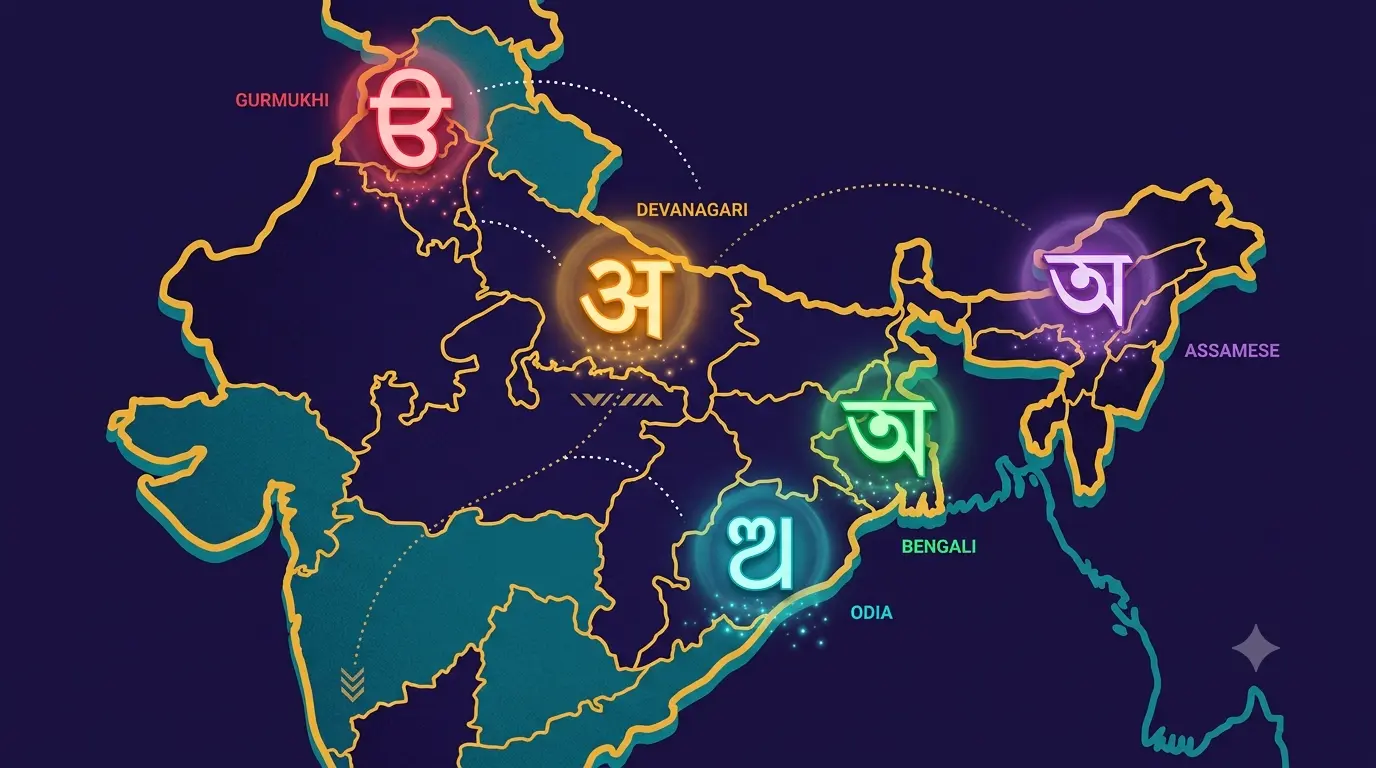
The growth case for underserved Indian language content is no longer a thesis. It's a track record. Hoichoi has 13 million subscribers across 100 countries on Bengali alone, with 82% monthly retention among overseas subscribers and 40% of revenue from international markets. Chaupal has built a profitable Punjabi, Haryanvi, and Bhojpuri streaming business since 2021. Punjabi content viewership grew 55% year-on-year in 2024. The audiences exist, they pay, and they retain — often at rates better than Hindi or English content, because the competition for their attention is structurally weaker.
The barrier is not demand. The barrier is that the subtitle vendor you use for Hindi or Tamil probably cannot deliver Bhojpuri, Punjabi, or underserved Indic languages at production quality. And the vendor who tells you they can — without being asked to prove it — probably can't either.
Underserved Indian language subtitle production is the process of generating accurate, timed subtitle files for content in languages like Bhojpuri, Punjabi, Bengali, Odia, Maithili, Assamese, and Santali — languages with large and growing content audiences but limited availability of trained AI models, qualified human reviewers, and vendors with proven production experience. It is underserved not because the audiences are small, but because global AI models and most localization agencies have not invested in the training data, language expertise, and quality infrastructure these languages require. The opportunity is structural: the platform that invests in Bhojpuri or Punjabi subtitle quality now is operating in a space where quality is genuinely scarce.
Why these languages are underserved by generic vendors
The reason Bhojpuri, Punjabi, and Bengali subtitle production is harder to source reliably than Hindi or Tamil is structural, not incidental. Three factors compound each other:
Training data scarcity. AI subtitle models improve with training data — the more labelled audio in a given language, the better the model's accuracy on new content in that language. Hindi gets the most training data of any Indian language, followed by Tamil, Telugu, and Bengali. Bhojpuri, Punjabi, Haryanvi, Maithili, and Assamese have significantly smaller labelled audio datasets publicly available. A model trained on insufficient Bhojpuri data produces higher word error rates on Bhojpuri content than on Hindi content, and no configuration of that model can close the gap — it needs more training data, not more settings adjustment.
Dialect variation that generic models ignore. Bhojpuri is spoken across Bihar, eastern UP, and a substantial diaspora in Mauritius, Fiji, and the Caribbean — and the spoken form differs meaningfully across these geographies. Punjabi is spoken in Punjab (India), Punjab (Pakistan), and the diaspora communities across Canada, the UK, the US, and the Gulf, with phonetic and vocabulary variation that a single generic Punjabi ASR model handles inconsistently. Bengali has a significant divide between the dialect spoken in West Bengal and the one spoken in Bangladesh — Hoichoi's content crosses both markets, but a subtitle model trained primarily on one dialect underperforms on the other. Generic vendors who list these languages in their supported list are usually offering a single monolingual model with no dialect-specific calibration.
Limited qualified reviewer availability. The quality assurance step in subtitle production — native-speaker review — requires qualified reviewers with both language fluency and subtitle editing experience. For Hindi, Tamil, and Telugu, the pool of qualified subtitle reviewers is large enough that most managed services can source them reliably. For Bhojpuri, Maithili, Assamese, and Santali, the pool is significantly smaller, and vendors who don't maintain standing relationships with qualified reviewers in these languages will produce AI-only output or contract out review to translators who know the language but not subtitle-specific quality standards. The result is that the QA step — the one that catches the errors the AI makes on low-resource language content — is exactly the step most likely to be inadequate for underserved languages.
The audience opportunity that the ops barrier obscures
Bhojpuri has an estimated 50+ million speakers across Bihar, UP, and diaspora markets in Mauritius, Fiji, and the Caribbean. It has a massive TV ecosystem and no serious streaming platform serving it. The content appetite exists — Bhojpuri films and music have been consumed at scale through physical media, local television, and YouTube for decades. The gap is that no platform has made a serious production-quality investment in Bhojpuri streaming content, partly because the ops infrastructure — including subtitle production — has been hard to source reliably.
Marathi has 85 million speakers and is India's third-largest language, spoken in Maharashtra — home to Mumbai — with a thriving film and theatre ecosystem, yet there's no dedicated OTT platform at scale. The viewers are there. The content ecosystem is there. The operational infrastructure for serving them at platform quality is where the gap sits.
Punjabi content viewership jumped 55% year-on-year in 2024, and the Punjabi diaspora — 35 million-strong across North America, the UK, Australia, and the Gulf — represents one of the highest-ROI regional bets available for any platform entering international Indian audiences. The diaspora subscriber is a premium audience: willing to pay more, retains better (as Hoichoi's 82% international retention rate demonstrates), and is underserved by every platform whose primary focus is the domestic Indian market.
For a content ops or growth lead at a platform expanding into these languages, the subtitle production problem is not a reason to wait. It's an ops problem to solve before the content launches — because a platform that goes live with Bhojpuri content and poor subtitle quality is spending the same production budget to deliver a worse viewer experience than a competitor who solved the ops problem first.
What to ask any vendor before committing
The questions below are specifically calibrated to reveal whether a vendor's claimed capability in underserved Indian languages is genuine or nominal. A vendor who can answer all of them specifically and with evidence has real capability. A vendor who gives vague answers to more than two of them does not.
- What is your word error rate on [specific language] content? Ask for a specific number, not a claim of "high accuracy." If they can't provide a measured WER on your language, they're not measuring accuracy on that language.
- How many hours of [specific language] content have you subtitled in the last 6 months? Recent production volume in the specific language is the most reliable predictor of operational readiness. A vendor who has done 2 hours of Bhojpuri in the last year is not operationally ready for a 200-hour Bhojpuri content library.
- Who reviews [specific language] output, and what are their qualifications? Ask specifically whether native-speaker reviewers are on staff or contracted, and whether they have subtitle-specific training rather than just language fluency.
- Can you handle [specific dialect]? For Bhojpuri: Bihar dialect versus Fiji diaspora dialect. For Punjabi: Punjab India versus Punjab Pakistan versus Canadian diaspora Punjabi. For Bengali: West Bengal versus Bangladesh. The answer reveals whether the vendor has thought about dialect variation or is treating the language as monolithic.
- What does your correction process look like, and how do corrections affect future batches? A vendor whose corrections only apply to the current file is not a pipeline — they'll produce the same error rate on your next batch. A pipeline that incorporates corrections is building toward a lower correction rate over time.
Realistic turnaround and pricing for underserved language pairs
The practical realities of underserved language subtitle production differ from standard Hindi or Tamil production in three ways that affect both timeline and cost:
Turnaround is typically longer. AI transcription on underserved languages produces higher initial error rates, which means the human review pass takes longer — the reviewer is correcting more errors rather than approving a mostly-accurate file. For Bhojpuri or Maithili content, expect turnaround to be 20 to 40% longer than for comparable Hindi content with the same vendor.
Per-minute cost is higher. Smaller qualified reviewer pools, higher AI correction overhead, and longer turnaround push the per-minute cost for underserved languages above the rate for major Indic languages. A vendor offering the same per-minute price for Bhojpuri as for Hindi is either using AI-only output without genuine QA, or is underpricing the work in a way that will show up in quality.
Volume commitment accelerates quality improvement. For underserved languages specifically, a vendor or pipeline with a training investment in your specific language gets better over time in a way that one-off project commissioning doesn't enable. A platform that commits to recurring Bhojpuri subtitle production with a vendor who incorporates corrections is building a progressively better Bhojpuri model. A platform that commissions three separate one-off projects from three different vendors starts from scratch each time. ButterCut's approach to underserved Indic language production is structured around exactly this: client-specific corrections and vocabulary maintained across batches, so the seventh batch performs better than the first.
Where it works and where it doesn't
Where investing in underserved language subtitle quality pays off
- Regional OTT platforms launching Bhojpuri, Punjabi, or Bengali content libraries, where subtitle quality is a direct signal of platform seriousness to an audience used to being underserved
- The viewer's first experience of the platform in their language sets long-term retention expectations — which is why subtitle quality in underserved Indian languages is a retention investment, not just a production cost.
- Platforms targeting diaspora audiences in the UK, Canada, US, and Gulf, where the premium subscriber is more likely to pay and retain if the content quality — including subtitles — matches what they expect from global platforms
Where it doesn't pay off
- Content that's being tested in a language before production investment is confirmed — the ops cost of subtitle quality for underserved languages is better spent after the content slate is committed, not during audience testing
- Very low volume one-off projects where the setup cost of building a vendor relationship with genuine capability in an underserved language doesn't amortise across enough content
FAQ
Are there AI tools that specifically support Bhojpuri subtitling?
Bhojpuri has limited AI model support compared to Hindi or Tamil. The Bhashini platform — India's National Language Technology Mission — is building Bhojpuri language AI as part of its mandate, and some India-specific AI subtitle pipelines have Bhojpuri training data. Generic global tools (Whisper, Google Speech, Azure) have minimal Bhojpuri training data and produce high error rates on Bhojpuri content. The reliable test is to send a 5-minute Bhojpuri clip to the vendor and compare the output to the audio — not to rely on language support claims in the product documentation.
Is Bengali subtitle service easier to source than Bhojpuri?
Yes, significantly. Bengali has a substantially larger AI training dataset, a larger pool of qualified human reviewers, and an established OTT ecosystem (Hoichoi) that has driven demand for professional Bengali subtitle production. The dialect question — West Bengal versus Bangladesh Bengali — is the primary variable to clarify with any vendor. Bhojpuri and Maithili are meaningfully harder to source than Bengali at production quality.
Does Punjabi subtitle quality differ between India and diaspora content?
Yes. Punjabi spoken in Punjab India differs from Punjabi spoken in Pakistan and from the diaspora variants in Canada and the UK, particularly in vocabulary, loanwords, and register. Content produced by the Canadian Punjabi diaspora for a Canadian audience uses a different register than rural Punjab content on Chaupal. A vendor who has calibrated for one context may produce errors on the other. Clarify which Punjabi audience the content is targeting before briefing any vendor on Punjabi production.
How do I evaluate a sample in a language I don't speak?
The sample evaluation approach for underserved languages doesn't require in-house fluency. Send a 5-minute clip to the vendor, receive the subtitle file, and run three tests: play the video with subtitles on and look for obvious synchronisation issues (timing failures are visible without language knowledge); share the subtitle file with a speaker of the language — not a subtitle professional, just a native speaker — and ask whether it sounds natural; and check the rendered script for visual errors (broken glyphs, wrong character rendering) against a reference text in the same language available online. These three checks catch the most common classes of underserved language subtitle failure without requiring a specialist reviewer in-house.
The audiences for Bhojpuri, Punjabi, Bengali, and underserved Indian language content exist, pay, and retain at rates that disprove the "niche market" framing. The operational barrier is that the subtitle vendor infrastructure for these languages hasn't caught up to the audience opportunity. Most vendors who claim support for these languages are offering AI-only output with inadequate training data and no specialist human review — which produces correction overhead that grows with content volume rather than shrinking. The platform that solves the subtitle ops problem for an underserved language before its competitors do is not spending more to reach that audience. It's building a quality moat in a space where the competition is producing substandard output.
If your platform is expanding into Bhojpuri, Punjabi, Bengali, or another underserved Indian language and needs a subtitle partner with genuine production capability rather than a language checkbox, ButterCut builds and maintains Indic language pipelines for exactly these markets. Book a free demo to run the vendor qualification checklist on your specific language and content type.
Sources
- Atpati Films / Medium, Why India Needs More Regional OTT Platforms in 2026 — Bhojpuri 50M+ speakers, no serious streaming platform; Punjabi diaspora 33M domestic speakers
- Broadcast and CableSat, Regional OTT in India: The Current Frontier — Punjabi viewership +55% YoY 2024; Marathi 85M speakers, no dedicated OTT at scale; Tier-2/3 cities 60-70% of viewership
- The Streaming Lab, Regional OTT Playbook 2025 — Hoichoi 13M subscribers, 100+ countries, 82% international retention, 40% revenue from overseas
- Infowind, Top Regional OTT Platforms India — Chaupal TV Punjabi/Bhojpuri/Haryanvi OTT launched 2021; regional language UI and subtitle options
- Auto Interview AI, Vernacular AI in India 2026 — Bhashini 40% multilingual accuracy improvement; India-specific language training requirements