



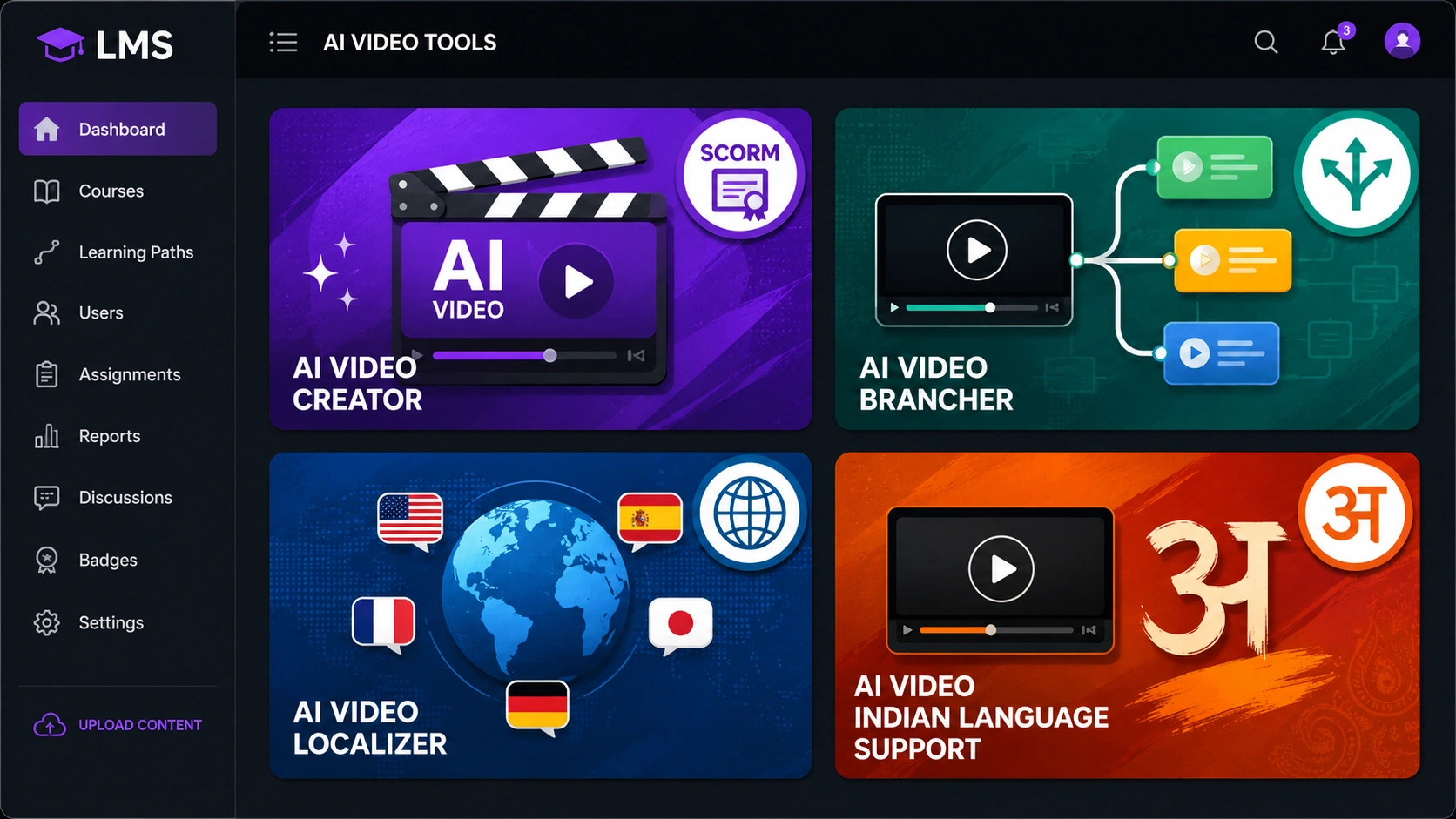
Most "best AI video tools" lists rank by avatar realism, language count, and features. An EdTech buyer has a different set of criteria: will it export to my LMS in a SCORM-compatible format, does it handle lecture-style audio with domain-specific vocabulary accurately, and does the Indic language quality hold up for learners in regional Indian markets? This ranking scores tools against those criteria specifically.
An AI video tool for EdTech and e-learning is software that generates or processes training and course video using AI — through avatar-based presenter video, AI transcription and subtitling, automated course assembly from documents, or a combination of these. For e-learning specifically, it must produce output that integrates with an LMS through standard formats (SRT, VTT, SCORM, xAPI), meets accessibility standards where required, maintains accuracy on educational domain vocabulary, and delivers multilingual output that learners in each target language market can actually comprehend. EdTech AI video requirements are a strict subset of general AI video requirements, and a tool that works well for marketing content may fail significantly on these criteria.
The EdTech-specific scoring criteria
Before ranking, it's worth being explicit about the four criteria that distinguish EdTech AI video requirements from general use:
SCORM and xAPI export. SCORM is the packaging standard that lets a video or interactive module be uploaded to a SCORM-compliant LMS and have completion and quiz data tracked automatically. Most AI video tools don't support SCORM natively — they export video files, not SCORM packages. Tools that do support SCORM often gate it behind Enterprise pricing. This is the most commonly overlooked requirement in EdTech AI video tool selection.
Lecture-style audio handling. EdTech content has audio characteristics that differ from marketing video: a single presenter speaking at length about a specific subject, often with domain-specific vocabulary, technical terminology, and slower, more deliberate pacing than conversational speech. AI transcription trained on general audio performs adequately on this type of content for common vocabulary and drops meaningfully for domain-specific terms.
Indic language accuracy for Indian course libraries. An Indian EdTech platform distributing courses in Hindi, Tamil, or Telugu needs AI video tool output that is accurate enough in those languages to support learner comprehension. This is not the same bar as "Hindi is listed as a supported language."
Accessibility compliance. Closed captions meeting WCAG 2.1 Level AA are a legal requirement for educational content in many regulated contexts and an ethical standard in the others. WCAG-compliant captions include accurate speech transcription, speaker identification, and relevant non-speech audio cues — not just text on screen.
The ranking
Synthesia — best for enterprise-scale multilingual training content
Synthesia is the incumbent choice for large organisations producing avatar-based training video at scale across many languages. Its Express-2 model delivers the highest avatar realism in the category, 140+ language support with one-click translation and AI dubbing, and a compliance posture (SOC 2 Type II, ISO 27001, ISO 42001, GDPR) that satisfies enterprise procurement. SCORM export is available but gated to Enterprise plans, which require a custom sales conversation and pricing. Content moderation — human review of every video before it publishes — adds hours to days to the timeline, which matters for organisations with frequent content updates.
For Indian EdTech specifically: Synthesia supports Hindi among its 140+ languages, but the underlying model is not purpose-built for Indic language educational content. Code-switching, regional accent variation, and domain vocabulary in Hindi or Tamil will be handled by a general multilingual model rather than a trained Indic pipeline. For organisations whose primary requirement is global multilingual reach across European and major Asian languages at enterprise scale, Synthesia is the strongest choice. For organisations whose primary need is Indic language accuracy, it's not the right tool.
Colossyan — best for interactive LMS-integrated training courses
Colossyan is the most purpose-built L&D tool in this category. It produces AI avatar video and packages the output as interactive training courses — with branching scenarios, mid-video quizzes, scored assessments, and structured learning paths — rather than standalone video files. SCORM 1.2 and xAPI export are available on Business plans ($70/month annually) without requiring an Enterprise contract. The comparison with Synthesia is instructive: Colossyan wins for interactive, SCORM-ready training at lower price points; Synthesia wins for avatar realism and language breadth. For an EdTech team building structured courses that need to live inside an LMS with completion tracking and quiz scoring, Colossyan is a stronger fit. Trusted by Paramount, Ericsson, and Cisco.
Content updates are meaningfully better handled than in Synthesia: when a compliance regulation changes or a product UI updates, Colossyan lets teams edit specific scenes without rebuilding the entire video, and existing translations stay intact. Synthesia requires re-rendering for most changes. The limitation is language coverage — 100+ languages versus Synthesia's 140+ — and Indic language quality faces the same constraint as Synthesia: good general coverage, not purpose-built for the Indian educational content use case.
HeyGen — best for multilingual translation and dubbing of existing content
HeyGen's primary EdTech use case is translating and dubbing existing course video into multiple languages with lip-synced AI audio — taking an English-language course and producing a Hindi, Tamil, or Telugu version where the avatar's lip movement matches the translated audio. This is a different workflow from creating new content from scratch, and it's where HeyGen's 175+ language support and avatar realism justify the higher cost. SCORM is available on Business plans ($149/month plus $20 per additional seat). The credit system is a practical constraint at volume — premium avatar credits consume more quickly than the headline plan price implies, and teams running high-volume content updates frequently report the credit math making HeyGen expensive relative to what they expected.
For Indian EdTech specifically, HeyGen's multilingual dubbing capability is the most relevant feature — translating an existing English course into Hindi or Tamil with synchronized AI audio. The same caveat about Indic language quality applies: the translation model serves general Hindi well and code-switched or educationally domain-specific Hindi less reliably.
ButterCut — best for Indian EdTech with Indic language subtitle and subtitle-plus-sync requirements
ButterCut occupies a different position from the tools above. Where Synthesia, Colossyan, and HeyGen are AI avatar video creation tools that also offer some subtitle functionality, ButterCut is a managed Indic language subtitle and localization pipeline that serves EdTech platforms distributing course content across Hindi, Tamil, Telugu, Bengali, Marathi, Kannada, and Malayalam. The core value isn't avatar generation — it's producing subtitle tracks for existing course video that are accurate enough in Indic languages to genuinely support learner comprehension, with native-speaker QA, domain-aware terminology review, and LMS-ready SRT and VTT delivery built into the workflow.
For an Indian EdTech platform with a library of English-language course content that needs Indic language subtitle tracks for regional learner segments, ButterCut's managed subtitle pipeline covers the use case that Synthesia, Colossyan, and HeyGen nominally support but structurally underserve — Indic language accuracy at the level educational content requires, at library scale.
Comparison table
| Tool | SCORM export | Indic language quality | Interactive training | Starting price | Best EdTech use case |
|---|---|---|---|---|---|
| Synthesia | Enterprise only | Listed (not purpose-built) | Limited (no branching) | $29/mo Starter; Enterprise for SCORM | Enterprise multilingual avatar training at scale |
| Colossyan | Business plan ($70/mo) | Listed (not purpose-built) | Yes — branching, quizzes, paths | $19/mo Starter | Interactive SCORM-ready LMS courses |
| HeyGen | Business plan ($149/mo) | Listed (not purpose-built) | No | $24/mo Creator | Multilingual dubbing of existing content |
| ButterCut | SRT/VTT LMS delivery | Purpose-built — 7 Indic languages | N/A (subtitle pipeline) | Volume-based; contact for pricing | Indic language subtitle tracks for existing course libraries |
Where each tool fits
Where it works
- Synthesia: Large enterprises producing avatar-based training video in 10+ languages at scale, with enterprise compliance requirements and budget for Enterprise pricing
- Colossyan: EdTech teams building interactive, quiz-integrated courses for LMS delivery, particularly compliance, onboarding, and skills training where branching scenarios add value
- HeyGen: Organisations translating and dubbing existing course video into multiple languages, particularly where lip-sync accuracy in the translated audio is the primary requirement
- ButterCut: Indian EdTech platforms adding Indic language subtitle tracks to an existing English-language course library, where accuracy in Hindi, Tamil, Telugu or other regional languages directly affects learner outcomes
Where it doesn't
- None of these tools is appropriate for live lecture captioning — that's a real-time workflow requiring a different technology stack
- Synthesia and HeyGen are not the right choice for interactive course authoring with branching and SCORM without an Enterprise contract
- ButterCut is not an avatar video creation tool — organisations needing to generate new AI avatar course video need Synthesia, Colossyan, or HeyGen
FAQ
Which AI video tool has the best SCORM support for e-learning?
Colossyan offers SCORM 1.2 and SCORM 2004 export on Business plans ($70/month) without requiring an Enterprise contract — the most accessible SCORM export at a self-serve price point. Synthesia gates SCORM to Enterprise. HeyGen added SCORM on Business plans ($149/month). For teams that need SCORM without Enterprise pricing, Colossyan is the clearest choice.
Can AI video tools handle domain-specific educational vocabulary accurately?
Accuracy on domain-specific vocabulary varies. General vocabulary is handled well by most tools. Technical, medical, legal, and field-specific terminology is where AI models trained on general content struggle. Custom glossary support — available in HappyScribe, 3Play Media, and some other tools — helps maintain consistency but doesn't fully solve the underlying transcription accuracy problem. Human review is the reliable fix for high-stakes domain-specific content.
Do AI video tools support Hindi and Indian regional languages for EdTech?
All major tools list Hindi among supported languages. Quality for educational content varies significantly. Generic AI models produce adequate Hindi for common vocabulary and poor Hindi for domain-specific educational terms and code-switching. For Indian EdTech where regional language subtitle accuracy is tied to learner comprehension, a purpose-built Indic language pipeline is meaningfully more reliable than a global tool's India language option.
What is xAPI and when do I need it instead of SCORM?
xAPI (Tin Can API) is a newer learning data standard that tracks a wider range of learning activities than SCORM — including mobile, simulation, and informal learning events. SCORM is sufficient for most LMS tracking needs; xAPI is appropriate for organisations running advanced learning analytics or tracking learning activities outside a traditional LMS. Most EdTech teams start with SCORM and add xAPI when their analytics requirements grow beyond what SCORM can track.
The best AI video tool for EdTech depends on whether you need to create new avatar-based course video (Synthesia or Colossyan), translate and dub existing content into multiple languages (HeyGen), or produce accurate Indic language subtitle tracks for an existing course library (ButterCut). The four tools serve distinct primary use cases that don't fully overlap. SCORM export — the feature that makes AI-generated video trackable inside an LMS — is gated to Business or Enterprise plans across all tools except Colossyan, where it's accessible on a standard paid plan. Indic language accuracy for educational content remains a gap in all three avatar tools; it's the specific capability ButterCut is built around.
If your Indian EdTech platform has an existing English-language course library that needs Indic language subtitle tracks accurate enough to support learner comprehension rather than just provide a text overlay, ButterCut is the right conversation. Book a free demo to see the quality difference on a sample from your content.
Sources
- Colossyan, Best Synthesia Alternatives 2026 — Colossyan $19/mo Starter, $70/mo Business with SCORM; Synthesia SCORM Enterprise only
- Ngram, Colossyan vs Synthesia 2026 — SCORM availability, branching, interactive features comparison
- AI Tools Bakery, Colossyan Review 2026 — SCORM 1.2 and SCORM 2004 on Business plans; xAPI on Enterprise
- Colossyan, HeyGen vs Synthesia 2026 — HeyGen Business $149/mo with SCORM; Synthesia compliance certifications
- Neuwark, Synthesia vs Colossyan 2026 — Synthesia for global multilingual scale; Colossyan for interactive learning engagement