



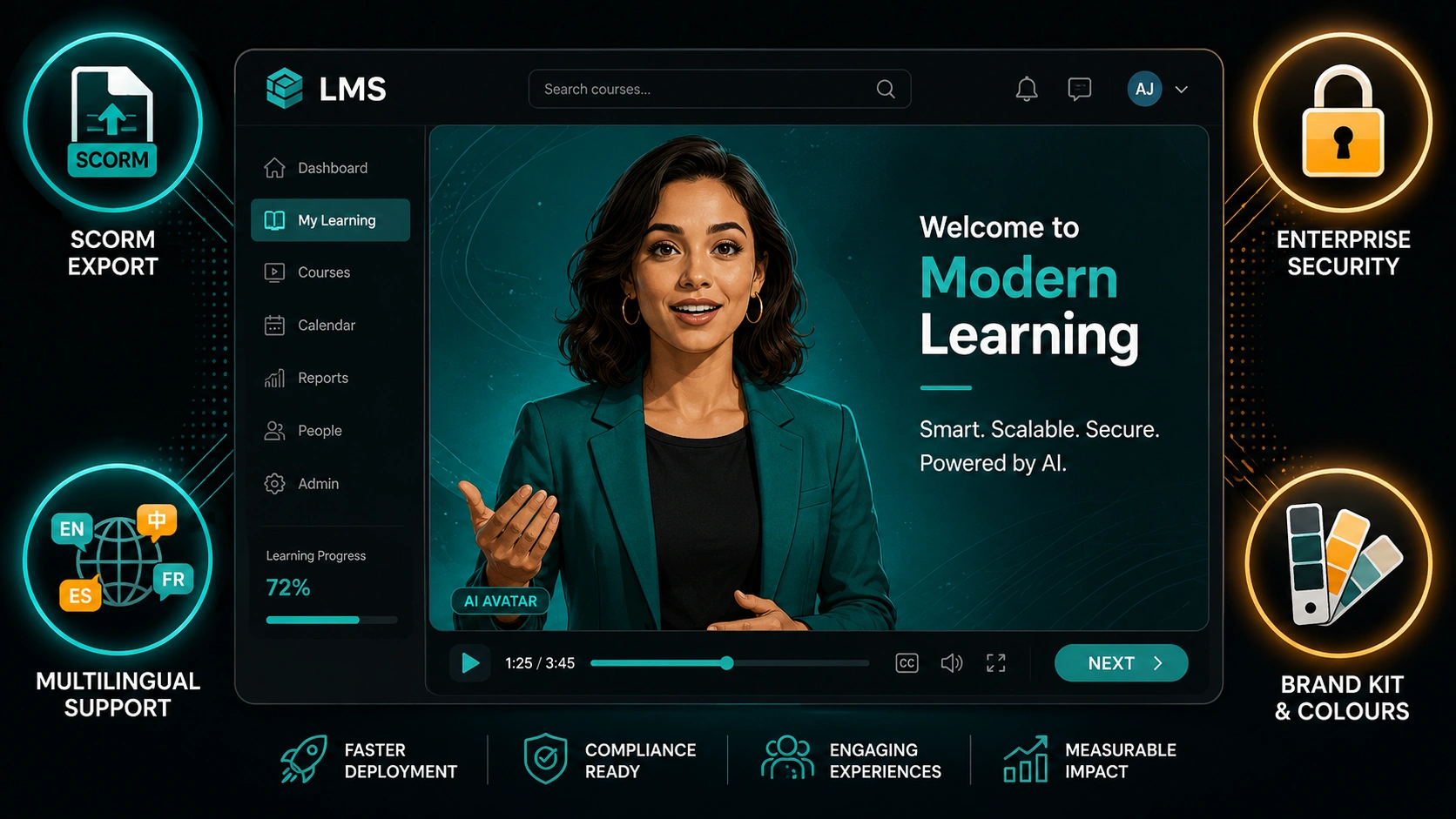
The L&D manager sourcing AI video tools for a corporate training programme isn't looking for the same things as a content creator. The questions that matter are different: does it export SCORM packages that integrate with our LMS, does it meet our data security standards, can it deliver in Hindi or regional languages for our distributed workforce, and does it maintain brand consistency across a library of hundreds of modules? This ranking is built around those questions.
An AI video tool for corporate training is software that produces training and L&D video content using AI — through avatar-based presenter video, document-to-video conversion, interactive scenario building, or AI-assisted subtitling and localisation — and integrates the output with a corporate learning management system through SCORM, xAPI, or direct LMS connectors. For corporate L&D specifically, it must also meet data security requirements (SOC 2 Type II, GDPR, and increasingly HIPAA for regulated industries), support brand and compliance governance at team level, and produce content that is maintainable over time as regulations and policies change.
The five corporate L&D requirements that consumer tools don't address
SCORM and xAPI export for LMS integration. Corporate training content almost always lives inside an LMS — Cornerstone, SAP SuccessFactors, Workday Learning, TalentLMS, Docebo. For a video to be trackable inside those systems, it needs to be packaged as a SCORM module with completion status and quiz scoring that syncs to the LMS. Most AI video tools don't support this natively, and the ones that do often gate it behind Enterprise pricing.
Data security certification. Enterprise procurement requires vendors to meet minimum data security standards before procurement can proceed. SOC 2 Type II is the baseline for most large Indian and global organisations. GDPR compliance is required for any organisation handling EU employee data. ISO 27001 and increasingly ISO 42001 (AI governance) are appearing in enterprise RFPs. A tool that doesn't meet these standards can't clear security review regardless of how good the features are.
Multi-language delivery for distributed workforces. For Indian organisations with workforces spanning multiple states and language communities, training content needs to be comprehensible in Hindi and regional languages — not just available with a language option that produces stilted output. The quality bar for a compliance or safety training video in Hindi is higher than for social media content, because the consequence of a Hindi-speaking employee misunderstanding the content is real and measurable.
Brand and compliance governance. Corporate training content must be brand-consistent across a library that may include hundreds of modules created by different team members over time. Brand kits — consistent avatars, fonts, colour palettes, and voiceover styles — prevent drift that makes a training library look internally inconsistent. Approval workflows and role-based permissions prevent unreviewed content from being deployed to learners.
Content maintainability. Training content is not produced once. Compliance regulations change, policies update, products evolve, and new market context requires scenario refreshes. A tool that requires rebuilding a full video from scratch every time a single slide or regulatory reference changes is not viable for a large corporate training library. The right tool allows scene-level editing that leaves the rest of the module intact.
The ranking
Synthesia — the incumbent for enterprise corporate training
Synthesia is the dominant choice for large enterprises producing avatar-based training video at scale. SOC 2 Type II, ISO 27001, ISO 42001, and GDPR compliance satisfy enterprise security review in most contexts. The Express-2 avatar model produces the highest realism in the category, and 140+ language support with one-click translation handles multilingual training rollout at enterprise scale. Over 60% of Fortune 100 companies use Synthesia for corporate training content. The content moderation process — human review of every video before it publishes — is both a safety feature and a bottleneck: publishing delays of hours to days affect time-sensitive compliance updates.
The critical limitation for corporate L&D: SCORM export requires an Enterprise contract. Brand kits, SSO, and 1-click translation are also gated to Enterprise. For large organisations with IT procurement capacity for Enterprise contracts, this is a manageable trade-off. For mid-market organisations whose training volume doesn't justify Enterprise pricing, Synthesia's corporate training feature set is partially inaccessible at the plans they can afford.
For Indian corporate training specifically: Synthesia's Hindi and regional language support is general-purpose rather than Indic-specialised. For onboarding or skills training where occasional imprecision is acceptable, this is adequate. For compliance, safety, or POSH training where precise comprehension in the target language is required, the quality gap relative to purpose-built Indic language pipelines is material.
Colossyan — best for L&D teams building interactive, SCORM-ready training
Colossyan is the strongest alternative to Synthesia for corporate L&D teams that need SCORM integration without an Enterprise contract. SCORM 1.2 and xAPI export are available on Business plans ($70/month annually). Branching scenarios, mid-video quizzes, and structured learning paths — features Synthesia doesn't offer at any tier — make Colossyan more appropriate for interactive training workflows where learners need to make decisions and see consequences, rather than passively watching a video. Trusted by Paramount, Ericsson, and Cisco. SOC 2 Type II certified, GDPR compliant.
Content update workflow is a genuine differentiator: when a compliance regulation changes, Colossyan allows editing the affected scene without rebuilding the entire module, and existing translations stay intact. Synthesia requires re-rendering for most changes. For a corporate L&D team managing a library of compliance and policy training that changes regularly, this matters operationally.
The limitation is language breadth — 100+ languages versus Synthesia's 140+ — which matters for global enterprises with training requirements in less common language markets. For Indian organisations distributing training across Hindi and major regional languages, Colossyan's language coverage is adequate; for organisations also distributing in Swahili, Vietnamese, or other less common languages, Synthesia's breadth may be necessary.
HeyGen — best for translating and dubbing existing training content
HeyGen's primary corporate L&D use case is translating existing training video into multiple languages with lip-synced AI audio — converting an English-language onboarding module into Hindi, Tamil, or Mandarin with an avatar whose lip movement matches the translated audio. This is meaningfully different from the Synthesia and Colossyan use cases, which involve creating new content from scratch. SCORM is available on Business plans ($149/month plus $20 per additional seat), which makes it among the more expensive self-serve options for SCORM functionality. SOC 2 Type II and GDPR compliance, but no published HIPAA documentation as of mid-2026.
The credit system is the most common complaint among corporate users: the headline plan price understates the effective cost at volume because premium avatar features consume credits quickly. A compliance training library with frequent updates can exhaust monthly credits faster than the plan implies. Running the credit math on your expected monthly output before committing to a plan is essential.
ButterCut — best for Indian organisations adding Indic language subtitle tracks to existing corporate training
ButterCut addresses a specific gap in the corporate L&D stack for Indian organisations: producing accurate Indic language subtitle tracks for English-language training content that is delivered to Hindi, Tamil, Telugu, Bengali, Marathi, Kannada, or Malayalam-speaking workforces. This is not an avatar creation tool — it's a managed Indic language subtitle pipeline with native-speaker QA, compliance-aware terminology review, and LMS-ready SRT and VTT delivery built in.
For an Indian corporate L&D team with an existing English-language training library that needs to be comprehensible to a regional-language workforce, ButterCut's managed subtitle pipeline is the right pairing with any of the tools above. Synthesia or Colossyan generates the training video; ButterCut produces the Indic language subtitle tracks at the quality level that compliance, safety, and POSH content requires. The two capabilities are complementary rather than competitive.
Comparison table
| Tool | SCORM export | Security certifications | Interactive training | Hindi/Indic quality | Starting price (SCORM tier) |
|---|---|---|---|---|---|
| Synthesia | Enterprise only | SOC 2, ISO 27001, ISO 42001, GDPR | Limited | General (not Indic-specialised) | Enterprise (custom) |
| Colossyan | Business plan — $70/mo | SOC 2 Type II, GDPR | Yes — branching, quizzes, learning paths | General (not Indic-specialised) | $70/mo Business |
| HeyGen | Business plan — $149/mo | SOC 2 Type II, GDPR | No | General (accent drift reported) | $149/mo Business |
| ButterCut | SRT/VTT for LMS; not SCORM packaging | Managed service; contact for security docs | N/A (subtitle pipeline) | Purpose-built — 7 Indic languages | Volume-based; contact for pricing |
Where each fits in a corporate L&D stack
Where it works
- Synthesia: Large enterprises with Enterprise procurement capacity needing avatar training video at scale across 10+ languages with the strongest compliance posture
- Colossyan: Mid-market L&D teams building interactive, quiz-integrated compliance and onboarding training for LMS delivery at Business plan pricing
- HeyGen: Organisations primarily translating and dubbing existing training content rather than creating new content from scratch
- ButterCut: Indian corporate L&D teams adding Indic language subtitle tracks to an existing English-language training library, particularly for compliance, safety, and POSH content where precise comprehension is required
Where it doesn't
- None of these tools handles live or real-time training captioning — that's a separate workflow
- For organisations needing HIPAA compliance, none of these tools has published a BAA as of mid-2026 — verify with vendors before deploying in healthcare or financial services contexts
- ButterCut is not an avatar video creation tool; organisations need one of the other three to generate training video content
FAQ
Which AI video tool has SCORM export without Enterprise pricing?
Colossyan offers SCORM 1.2 and SCORM 2004 on its Business plan at $70/month annually — the most accessible SCORM export at a self-serve price point. Synthesia gates SCORM to Enterprise. HeyGen offers SCORM on Business at $149/month. For corporate L&D teams that need SCORM without Enterprise contract overhead, Colossyan is the clearest choice.
Is Synthesia HIPAA compliant for healthcare training?
As of mid-2026, neither Synthesia nor HeyGen has published HIPAA compliance documentation or offered Business Associate Agreements. Both hold SOC 2 Type II and GDPR certification. Healthcare organisations processing Protected Health Information should confirm current compliance documentation with vendors directly before deploying these tools for regulated training content.
How do I maintain consistency across a large corporate training library produced with AI video?
Brand kits — consistent avatar selection, approved voice styles, font and colour palettes — are the primary consistency mechanism. In Synthesia and Colossyan, brand kits are available on paid and Enterprise plans respectively. Role-based permissions and approval workflows prevent individual team members from deploying content that hasn't been reviewed. A central glossary maintained across all content prevents terminology drift across modules.
What's the right approach for delivering Hindi training to a regional Indian workforce?
Two complementary approaches work together. First, create the training module using an AI avatar tool (Synthesia or Colossyan) and use their built-in Hindi translation for the voiceover. Second, add purpose-built Indic language subtitle tracks through ButterCut for the Hindi text that appears on screen — because the subtitle accuracy for compliance and safety content needs to be higher than what a general multilingual tool's Hindi output delivers. The two approaches together produce a more reliable comprehension experience than either approach alone.
The best AI video tool for corporate training depends on whether the priority is enterprise compliance credentials and language scale (Synthesia), interactive SCORM-ready training accessible without Enterprise pricing (Colossyan), multilingual translation and dubbing of existing content (HeyGen), or Indic language subtitle production for a regional Indian workforce (ButterCut). For Indian organisations, the most common gap is Indic language accuracy — the point where all three avatar tools nominally support Hindi but don't produce the quality that compliance or safety training content actually requires. Purpose-built Indic subtitle production is typically the right complement to any of the avatar tools, not a replacement for them.
For Indian corporate L&D teams whose compliance, safety, or POSH training content is delivered to Hindi and regional-language workforces and needs to be genuinely comprehensible rather than just subtitled, ButterCut produces the Indic language tracks that close that gap. Book a free demo to run a sample from your existing training library.
Sources
- Colossyan, Best Synthesia Alternatives 2026 — Colossyan pricing tiers, SCORM availability, security certifications
- Neuwark, Synthesia vs Colossyan 2026 — head-to-head corporate training workflow comparison
- Colossyan, HeyGen vs Synthesia 2026 — HeyGen Business $149/mo with SCORM; Synthesia compliance certifications; HIPAA status
- VidMetoo, Colossyan vs Synthesia — Synthesia 60%+ Fortune 100 adoption; compliance governance comparison
- AI Tools Bakery, Colossyan Review 2026 — branching scenarios, SCORM 1.2 and 2004 on Business; xAPI on Enterprise; G2 4.6/5 from 488 reviews