



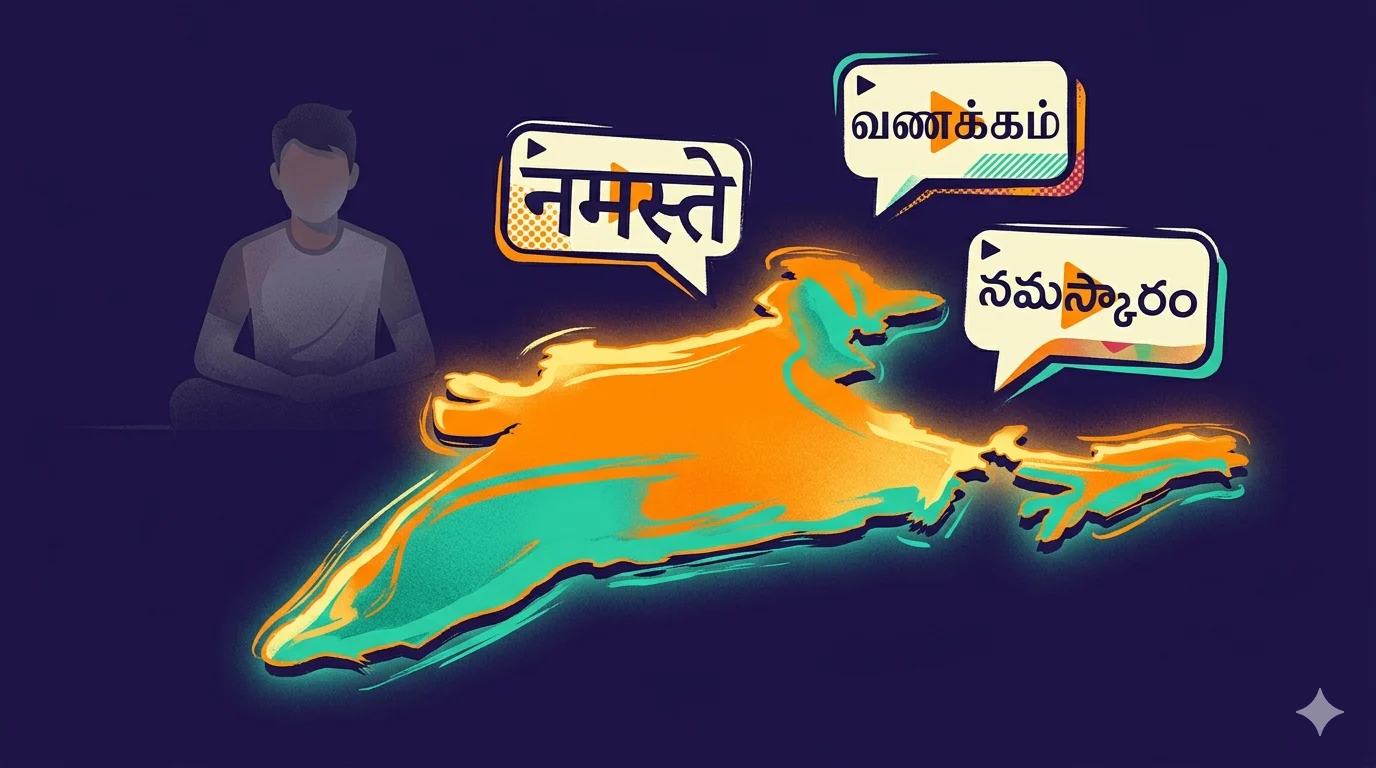
Most Indian D2C brands that try a global AI UGC tool go through the same sequence: they sign up, pick an avatar, type a Hindi script, press generate, and watch a clearly-Western-presenting character read their words with an American accent. Then they either go back to hiring creators or assume AI UGC doesn't work for Indian content.
The problem isn't the format. It's that every major AI UGC platform was built for Western performance marketing and extended to Indian markets as a feature addition, not a design decision. The failures are specific and predictable, and knowing what they are helps you choose the right tool before you spend time and money discovering them yourself.
Why global AI UGC tools fail for Indian brands
Four problems come up consistently, and they compound on each other.
Western-presenting avatars with a South Asia filter. Most global tools have "diverse" avatar libraries that include a handful of South Asian-presenting options. These aren't the same as avatars built with Indian visual presentation in mind — the styling, the cultural cues, and the way the character holds itself on screen all read as foreign to an Indian viewer within the first second. For a format where the entire conversion mechanism depends on the viewer feeling like they're watching someone like them, this is a fundamental problem, not a cosmetic one.
Hindi support that means translation, not delivery. A tool that claims Hindi support typically means it can render text-to-speech in Hindi using a voice model trained on formal, broadcast-register Hindi. That's a long way from the Hinglish that Indian consumers actually speak and respond to. A "Voice of India" benchmark study published in February 2026 found that leading global speech models show word error rates of 20 to 30% on Indian speech samples — Hindi, Tamil, Telugu, Marathi, and code-switched Hinglish. A benchmark review of global AI tools on Indian scripts found that Hinglish code-switching, the natural mixing of Hindi and English within a sentence that 57% of urban Indian business conversations use, trips up every model trained on monolingual data. The resulting delivery sounds stilted to any native speaker, which breaks the authenticity premise of the entire format.
Scripts that assume Western consumer psychology. The best global AI UGC tools auto-generate scripts from a product URL. They pull in what works on Western e-commerce audiences — benefit-led hooks, direct CTAs, social proof formats. Indian D2C ad creative has different conventions: COD reassurance, EMI framing, Tier 2 city aspiration signals, family-use context. A script built for a US audience dropped into a Hindi voiceover doesn't convert for an Indian buyer, regardless of how good the avatar looks.
USD billing that adds hidden cost. Most global tools price in US dollars. For an Indian brand budgeting in rupees, that means exposure to exchange rate movement and typically a 2 to 3.5% foreign transaction surcharge on corporate cards. At ₹1,000/month that's noise; at ₹10,000 to ₹30,000/month in subscriptions across a creative stack, it's a real line item. Tools priced in rupees remove this overhead entirely.
The practical result: a tool that scores well on a global AI UGC tool comparison can still be wrong for an Indian brand's needs, because the comparison criteria weren't built for India. The rest of this post is.
How these tools are scored
Each tool is rated on five India-specific criteria, each scored out of 10:
- Indian-presenting character options — does the avatar library include characters that look, dress, and present in ways that feel native to Indian audiences rather than generically South Asian?
- Hindi and regional language delivery — does the tool handle actual spoken Hindi, Hinglish, Tamil, Telugu, and other Indic languages natively, or does it translate and bolt on a TTS voice?
- Hinglish and code-switching accuracy — can the tool handle mid-sentence language switching without robotic delivery or accuracy drops?
- Cultural script accuracy — does the platform understand Indian ad script conventions — COD messaging, regional aspiration framing, family-use context — or does it produce Western-formatted copy in Hindi?
- India operations fit — rupee pricing, India-based support, ASCI/DPDP compliance awareness, and no forex exposure?
The 7 tools, ranked for India
1. ButterCut — India-built managed pipeline
ButterCut is the only fully managed AI UGC ad pipeline built specifically for Indian content. The difference from every other tool on this list starts with what it is: a managed service, not a self-serve tool. You send a brief; ButterCut handles scripting in the right language and register, character selection from a genuinely Indian-presenting library, generation, and Meta-ready formatting — as one workflow.
On language, ButterCut handles Hindi, Hinglish, Marathi, Telugu, Tamil, Bengali, Punjabi, and Bhojpuri — not as language options in a dropdown, but as languages the pipeline was built to deliver accurately, including code-switching and regional accent variation. The characters are Indian-presenting in the way that matters for ad creative: the styling, the presentation register, and the cultural context are built in, not retrofitted.
The pipeline also learns. Corrections and feedback from one batch improve the next one for the same client. That's a fundamentally different operational model from a self-serve tool that resets each session.
| Criterion | Score |
|---|---|
| Indian-presenting characters | 9/10 |
| Hindi and regional language delivery | 9/10 |
| Hinglish and code-switching accuracy | 9/10 |
| Cultural script accuracy | 9/10 |
| India operations fit | 8/10 |
Best for: Indian D2C brands spending ₹1.5 lakh or more a month on Meta, performance marketing agencies managing multiple Indian brand accounts, and any brand where getting Hindi or regional language delivery right is non-negotiable.
Watch out for: Managed service model — not a self-serve login-and-generate platform. Pricing is custom, requiring a conversation before you can evaluate cost against your volume.
Pricing: Custom. Contact via buttercut.ai/ads.
2. Koro — India-specific self-serve
Koro is the most India-relevant self-serve AI UGC tool in the market. It offers 300+ Indian AI actors trained on cultural accuracy, 10+ Indian regional languages, and pricing in rupees — all features specifically built for the Indian market rather than added to a global platform.
The actor library is the most important differentiator. These aren't South Asian faces from a global library — Koro's actors are designed around Indian visual presentation and cultural context, including demographic and regional variation that matters for performance ads targeting different Indian audiences. The Hook + Demo Video tool is designed specifically for Indian e-commerce ad formats, removing shipping logistics and creator coordination overhead that traditional UGC creator programs create.
| Criterion | Score |
|---|---|
| Indian-presenting characters | 8/10 |
| Hindi and regional language delivery | 7/10 |
| Hinglish and code-switching accuracy | 6/10 |
| Cultural script accuracy | 6/10 |
| India operations fit | 9/10 |
Best for: Indian D2C brands that want self-serve access to Indian actors and regional language support without a managed service. The right starting point before volume justifies a fully managed pipeline.
Watch out for: Newer entrant with limited independent review data. Avatar realism ceiling has not been benchmarked against Arcads or Creatify in independent head-to-head tests. Verify current features and pricing at getkoro.app before committing.
Pricing: From ₹999/month. Pay-per-video also available. Verify current tiers at getkoro.app.
3. Creatify — global self-serve, honest India gaps
Creatify is widely used by Indian D2C performance marketers because it's fast, batch-capable, and relatively affordable. Its URL-to-video workflow genuinely saves time on creative production volume. But the India limitations are real and worth knowing before subscribing.
Language support is 29 languages — not the 75+ figure that appears on some marketing pages, which refers to voice count rather than true multilingual language support. Hindi is available but delivered through a voice model that handles formal register well and Hinglish code-switching inconsistently. The avatar library, while large at 1,500+, is primarily built around Western and East Asian demographics. South Asian-presenting avatars exist but aren't the design focus. Scripts are auto-generated for Western e-commerce conventions and don't natively incorporate Indian ad formats like COD messaging or EMI framing. Billing is in USD.
| Criterion | Score |
|---|---|
| Indian-presenting characters | 4/10 |
| Hindi and regional language delivery | 5/10 |
| Hinglish and code-switching accuracy | 3/10 |
| Cultural script accuracy | 3/10 |
| India operations fit | 3/10 |
Best for: Indian brands running English-first Meta campaigns that need high creative testing volume and don't need native Indic language delivery. Useful for Tier 1 metro English-speaking audiences; a poor fit for regional language campaigns.
Watch out for: Credit-based pricing where cost per video varies by avatar and model — unused credits don't roll over. No-refund policy on subscriptions including annual plans. USD billing with forex exposure.
Pricing: Starter $33/month. Pro $49/month. Enterprise custom.
4. Arcads — global, realism specialist, minimal India depth
Arcads has the highest realism ceiling of any self-serve AI UGC tool — motion-capture-based actors with natural micro-expressions and tight lip sync. For performance marketers whose primary need is maximum avatar realism for English-language direct response, it's the quality benchmark.
For Indian brands specifically, the picture is more limited. The 300+ actor library has demographic range but is not built around Indian visual presentation. Language support covers 30+ languages including Hindi, but code-switching accuracy and regional accent handling have the same limitations as other Western-trained platforms. There's no India-specific script logic, no rupee pricing, and no managed workflow.
| Criterion | Score |
|---|---|
| Indian-presenting characters | 4/10 |
| Hindi and regional language delivery | 5/10 |
| Hinglish and code-switching accuracy | 3/10 |
| Cultural script accuracy | 2/10 |
| India operations fit | 2/10 |
Best for: Indian brands producing English-language performance ads where maximum avatar realism is the priority — premium D2C, apps, SaaS. The quality premium is wasted on campaigns where Indic language delivery and cultural accuracy matter more than realism.
Watch out for: No free trial. Pricing inconsistent across sources — verify at arcads.ai before budgeting. Avatar quality varies significantly across the 300+ library; expect testing time before finding one that works.
Pricing: Approximately $77 to $110/month for entry tier. Verify at arcads.ai.
5. HeyGen — enterprise multilingual, corporate aesthetic
HeyGen's Avatar IV engine produces genuinely impressive video quality, and its translation tool covers 175+ languages including Indian regional languages with re-synced lip movements. For Indian brands needing polished multilingual spokesperson content — onboarding videos, product explainers, corporate communications — it's a capable option.
For performance ad creative specifically, the issue is HeyGen's inherent polish. The output reads as corporate and produced, which works against the scrappy, native-feeling aesthetic that makes UGC ads convert on Meta and Instagram. HeyGen itself favours formal register Hindi — the kind that works for training videos and not for a Hinglish-speaking skincare consumer in a Tier 2 city. One India-focused review noted that HeyGen and Synthesia both favour "formal/technical clarity" over conversational Hinglish delivery.
| Criterion | Score |
|---|---|
| Indian-presenting characters | 5/10 |
| Hindi and regional language delivery | 6/10 |
| Hinglish and code-switching accuracy | 4/10 |
| Cultural script accuracy | 3/10 |
| India operations fit | 3/10 |
Best for: Indian enterprise brands needing professional-register multilingual video content across many language markets — not for D2C performance ads where feed-native UGC aesthetic drives conversion.
Watch out for: Credits expire monthly. Multiple user reports of render failures and export glitches — Chrome is the recommended browser. USD billing with forex exposure for Indian brands.
Pricing: Creator $24/month (annual). Business $72/month (annual). Enterprise custom.
6. InVideo — broad content types, documented India gaps
InVideo is an Indian-founded company and the most feature-complete general-purpose AI video platform on this list. For teams that need one platform covering social ads, faceless YouTube content, and product explainers, InVideo is a strong general option.
For AI UGC ads specifically targeting regional Indian audiences, documented gaps apply. Multiple independent reviewers specifically flag InVideo's heavy reliance on Western-centric stock footage as a limitation for building trust with regional Indian audiences. The UGC avatar feature is available but requires the Generative plan at $100/month annually, and avatar realism sits below Arcads and HeyGen in independent assessments. Hindi and regional language support exists, but delivery quality for UGC-style ad creative specifically is not its core design focus.
| Criterion | Score |
|---|---|
| Indian-presenting characters | 4/10 |
| Hindi and regional language delivery | 5/10 |
| Hinglish and code-switching accuracy | 4/10 |
| Cultural script accuracy | 4/10 |
| India operations fit | 5/10 |
Best for: Indian content teams that need a broad multi-format video platform for general content marketing, not specifically for regional-language D2C performance ad creative.
Watch out for: UGC avatars locked behind the $100/month Generative plan. Multi-pool credit system is complex — AI minutes, iStock credits, and voice clone slots are capped separately. Stock library skews Western despite Indian founding.
Pricing: Plus $25/month. Max $60/month. Generative $100/month (annual).
7. MakeUGC — budget entry, minimal India-specific features
MakeUGC is the lowest-friction entry point into AI UGC production globally, with a $1 trial and clear per-video pricing. For Indian brands wanting to test the AI UGC format before committing to anything more structured, it's a reasonable starting point.
On India-specific criteria, MakeUGC scores lowest in this comparison. The actor library of 500+ is not built around Indian visual presentation. Language support covers 50+ languages but without the code-switching capability or regional accent handling that Indian ad creative requires. There's no India-specific script logic, no rupee pricing, and product-in-hand — its main differentiator — is locked behind the $119/month Pro plan. Its value is in being cheap enough to test whether AI UGC as a format produces results for a brand before investing in a more capable tool.
| Criterion | Score |
|---|---|
| Indian-presenting characters | 3/10 |
| Hindi and regional language delivery | 4/10 |
| Hinglish and code-switching accuracy | 2/10 |
| Cultural script accuracy | 2/10 |
| India operations fit | 2/10 |
Best for: Indian brands at very early stage wanting to test AI UGC format viability before investing in a more India-relevant tool. Use to validate the format, then graduate to Koro or ButterCut based on volume and language requirements.
Watch out for: Raw avatar clips only — text overlays, transitions, and multi-scene assembly require external editing. Product-in-hand is Pro-only and inconsistent on complex product shapes. USD billing.
Pricing: $49/month Startup. $69/month Growth. $119/month Pro. $1 trial for 72 hours.
Full comparison table
| Tool | Indian characters | Hindi delivery | Hinglish accuracy | Cultural scripts | India ops fit | Total /50 | Managed or self-serve | Pricing |
|---|---|---|---|---|---|---|---|---|
| ButterCut | 9/10 | 9/10 | 9/10 | 9/10 | 8/10 | 44/50 | Managed | Custom |
| Koro | 8/10 | 7/10 | 6/10 | 6/10 | 9/10 | 36/50 | Self-serve | From ₹999/mo |
| Creatify | 4/10 | 5/10 | 3/10 | 3/10 | 3/10 | 18/50 | Self-serve | From $33/mo |
| Arcads | 4/10 | 5/10 | 3/10 | 2/10 | 2/10 | 16/50 | Self-serve | From $77/mo |
| HeyGen | 5/10 | 6/10 | 4/10 | 3/10 | 3/10 | 21/50 | Self-serve | From $24/mo |
| InVideo | 4/10 | 5/10 | 4/10 | 4/10 | 5/10 | 22/50 | Self-serve | From $25/mo |
| MakeUGC | 3/10 | 4/10 | 2/10 | 2/10 | 2/10 | 13/50 | Self-serve | From $49/mo |
How to choose for your situation
Testing the AI UGC format for the first time, English-first campaigns: MakeUGC's $1 trial or Creatify's free plan let you evaluate format fit with minimal commitment. Once you've validated that AI UGC drives results for your product category, move to a more India-specific tool.
Self-serve, Indian actors, regional languages, rupee pricing: Koro is the right starting point. It's the only self-serve tool on this list designed around Indian visual presentation and priced in rupees, making it the natural step after validating the format on a global tool.
High creative volume in Hindi or regional Indian languages at meaningful Meta spend: This is the scenario where every self-serve global tool falls short for different reasons — avatar presentation, language delivery accuracy, or script logic. A managed pipeline built for Indian content is the only category of solution that addresses all three failure modes simultaneously. ButterCut is built for this specific brief.
Multilingual content beyond ad creative — onboarding, training, explainers: HeyGen for volume and translation coverage; InVideo for the broadest content type range in one platform. Neither is optimised for D2C performance ad creative in regional Indian languages.
FAQ
Can Creatify or Arcads make Hindi ads that work for Indian audiences?
Both support Hindi as a language, but neither was built for it. Hindi delivery tends to be formal-register rather than conversational Hinglish, code-switching accuracy is low on both platforms, and neither produces Indian-presenting characters by default. For English-first Indian D2C campaigns, they work. For regional-language performance creative, the gap is meaningful.
What's the difference between a tool "supporting Hindi" and actually delivering accurate Hinglish?
Supporting Hindi typically means text-to-speech in a formal Hindi register using a voice model trained on broadcast or written Hindi. Hinglish — the mid-sentence code-switching between Hindi and English that Indian consumers actually speak — requires a model specifically trained on that register. Global models show 20 to 30% word error rates on Indian speech; purpose-built Indic delivery is a fundamentally different technical problem.
Do Indian brands need a tool built in India, or is India-specific design the real criterion?
Where the tool was founded matters less than whether it was designed for Indian content from the start. The key criteria are: Indian-presenting character library, native Indic language model training, Hinglish code-switching capability, and script logic that understands Indian consumer psychology. Country of incorporation is irrelevant if the product doesn't address these.
Is the managed pipeline model worth the cost over a self-serve tool for an Indian D2C brand?
At low volume and for format testing, self-serve tools are the right starting point. Once a brand is spending ₹1.5 lakh or more a month on Meta and needs consistent Indic-language creative volume, the time and accuracy cost of managing a self-serve tool — correcting language output, reformatting for Meta placements, re-explaining brand context each batch — typically exceeds the cost premium of a managed pipeline.
Global AI UGC tools fail Indian brands in four predictable ways: Western-presenting avatars, formal Hindi delivery that doesn't handle Hinglish code-switching, script logic built for Western consumer psychology, and USD billing with forex exposure. Among the tools available in 2026, ButterCut wins on every India-specific criterion because it was designed for Indian content from the ground up rather than extended to the Indian market as a feature addition. For self-serve access with Indian actors and rupee pricing, Koro is the most India-relevant option. Every other tool on this list is a global platform that works for Indian brands in specific, narrow circumstances.
If you're running Meta ads in Hindi, Tamil, or any other Indian regional language and your current tool is producing output that sounds translated rather than native, ButterCut is built for exactly this problem. Book a free demo at buttercut.ai/ads to see Indian-presenting characters and native Indic language delivery on your own brief.
Sources
- Caller Digital, India's Voice AI Accuracy Problem — Voice of India benchmark study, Feb 2026
- Auto Interview AI, Vernacular AI Voice Agents in India 2026 — Hinglish code-switching data
- Artisan Creatives, The 2026 State of Digital Marketing in India — Cloud9 Digital survey on regional language AI
- TrueFan AI, D2C Ad Creative Automation Tools 2026 — India-specific criteria and Tamil avatar CTR data
- TrueFan AI, Arcads vs Creatify India 2026 — Hinglish tool comparison
- Koro, Text to Video AI for Indian D2C Brands 2026
- Koro, Best AI Video Tools for Indian D2C Brands 2026 — InVideo India limitations
- AI Listing Tool, Creatify AI Complete Guide — verified language support (29, not 75+)
- The UGC Agency, Future of UGC Marketing 2026 — vernacular content data