



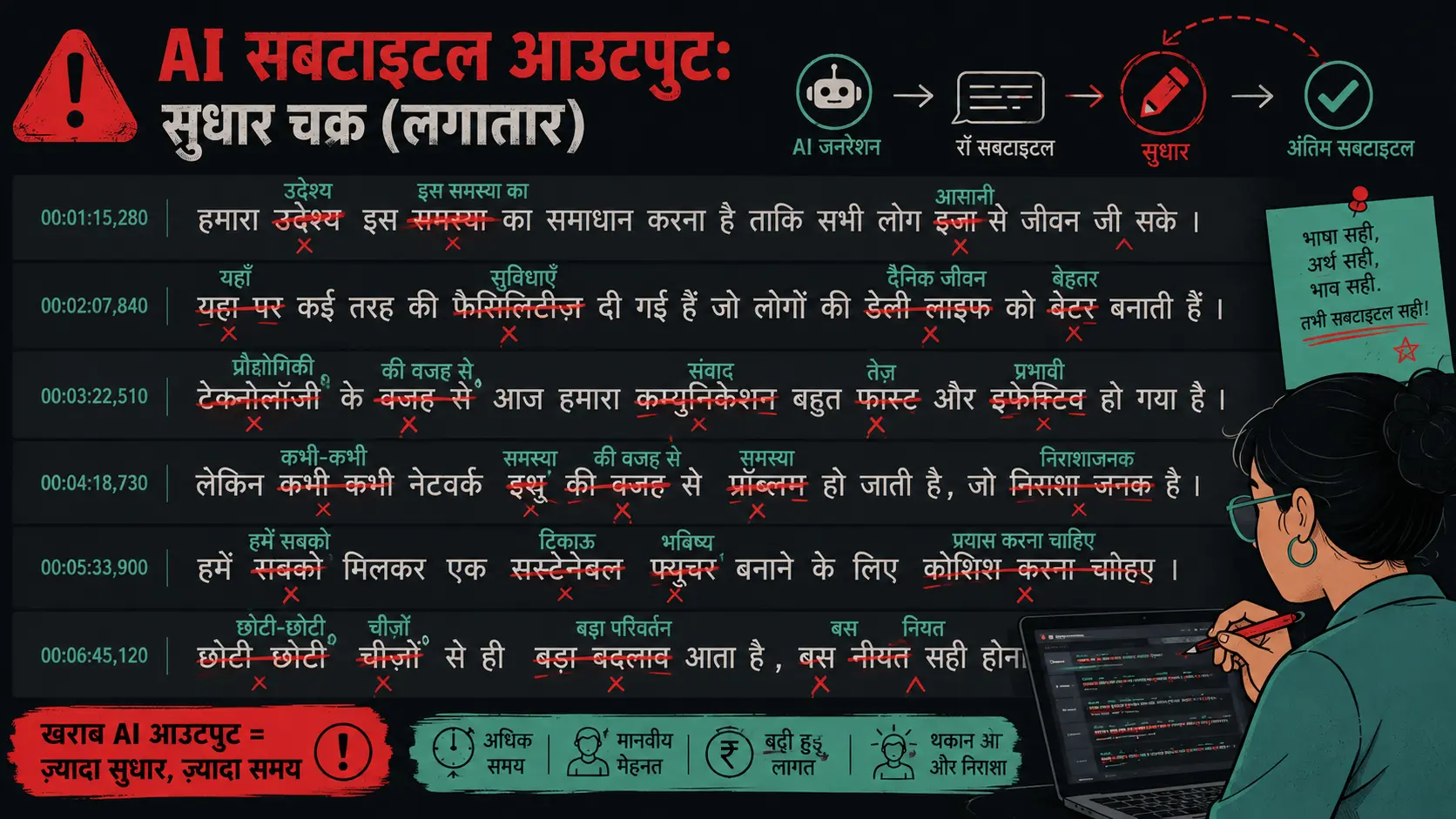
If you've sourced subtitle work for Hindi or regional Indian language content through a generic AI tool, you already know what happens. The output is plausible enough to look right on first scan. Then your reviewer opens it, and the corrections start. Wrong idioms. Stilted phrasing. English brand names rendered phonetically in Devanagari. Hinglish sentences where the model picked a language and stuck with it instead of tracking the switch. By the time the pass is done, the time "saved" by using AI has been spent on corrections, and your ops lead is asking why you're not just using a human.
The problem isn't AI subtitling. The problem is that "supports Hindi" means almost nothing as a quality signal — and the tools that say it loudest are often the furthest from actually delivering it.
Genuine AI subtitle support for Hindi and Indian languages means a model trained specifically on Indian speech data — not a global speech model with Hindi as one entry in a 120-language list. It works by learning the phonetic patterns, code-switching norms, dialectal variation, and domain vocabulary of actual Indian content, rather than applying a general multilingual model to audio it wasn't trained on. It produces output that a native-speaking reviewer can approve with minimal correction, and it improves with each correction rather than resetting the learning curve for the next project. The operational test is not demo accuracy on clean audio. It's correction rate on your actual content, at volume, over time.
Why global models fail on Indian speech
The "Voice of India" benchmark study published in February 2026 tested leading global speech recognition models — including products from OpenAI, Google, and Microsoft — on real Indian speech samples across Hindi, Tamil, Telugu, Marathi, Bengali, Kannada, and Malayalam. The results were unambiguous: global models showed word error rates of 20 to 30% on Indian speech. That means for every 10 words an Indian speaker says, two or three are misunderstood by the model.
In a subtitle context, a 20-30% word error rate doesn't mean one in five subtitles is wrong. It means almost every subtitle contains at least one error. Each of those errors requires a human reviewer to find it, correct it, and verify the surrounding timing. At any meaningful content volume — ten hours a week, fifty hours a month — that correction overhead is the biggest line item in your subtitle operations, and it grows proportionally with volume rather than shrinking as you scale.
The structural reason is simple and not going to change soon: Hindi gets approximately 2 to 5% of the training data that English gets in global models. Tamil, Telugu, Marathi, Bengali, and Malayalam get even less. A model that performs at 98% accuracy on American English and 72% on Indian language speech isn't a Hindi-capable model. It's an English model with Hindi listed in its documentation.
The specific failure mode: code-switching
57% of urban Indian business conversations mix Hindi and English within the same sentence. This isn't a quirk or an edge case — it's the default communication mode for the audience that a Hindi-language content platform is trying to serve. A piece of content where a speaker says "Yaar, is product ki delivery time kya hai, aur kya iska return policy flexible hai?" is perfectly natural Hindi. For a global ASR model, it's a sequence of language detection failures.
The model needs to: detect that language has switched mid-sentence, apply the correct phoneme set for the English words, render those words in the appropriate script (Roman for English brand names and technical terms, Devanagari for the Hindi portions), and then switch back without losing the timing context. Generic models handle this in one of three ways: they transliterate the English words into Devanagari (technically wrong), they drop them (factually wrong), or they switch the entire sentence to one language (naturalness wrong). Any of these produces output that a native Hindi speaker immediately recognises as machine-generated and uncorrected.
Even models specifically trained on Indian data show accuracy drops of 3 to 8 percentage points on Hinglish code-switched speech compared to pure Hindi. For a growth or content ops lead managing subtitle delivery across a platform with significant Hinglish content — which is most urban Indian content — this is the most reliable predictor of correction volume.
What the correction cycle actually costs
The cost of bad Hindi subtitle output doesn't appear in the per-minute price of the AI tool. It appears in the correction cycle that follows every batch:
- A reviewer opens the subtitle file and begins marking errors. At a 20-30% word error rate, this is not a light QA pass — it's a line-by-line correction job on a file that was supposed to be close to final.
- The corrections go back to the vendor, or into the tool's editor, or are made manually by someone in-house. Each of these options has a time cost and a labour cost.
- If the vendor receives the corrections, they either learn from them for this specific project or they don't — and next month's batch starts with the same error rate as last month's.
- If the corrections are made internally, they're done at your team's fully-loaded cost per hour, which is typically higher than the vendor's per-minute rate.
The total cost of subtitle operations for a content platform is not the per-minute price of the tool. It's the per-minute price of the tool plus the per-hour cost of the correction cycle multiplied by the correction volume. For platforms using generic AI tools on Indian language content, the correction cycle is routinely the larger of the two numbers.
What genuine Hindi subtitle support looks like in practice
The gap between claimed and genuine Hindi support shows up on four specific tests that any content platform can run on a sample from their own content before committing to a vendor:
Code-switching accuracy test: Take a 5-minute clip of typical content where the speaker mixes Hindi and English naturally. Run it through the tool. Count how many code-switched phrases are handled correctly — the English words in Roman script, the Hindi words in Devanagari, the sentence timing intact. A tool with genuine Hinglish support handles this without producing transliterated English or collapsed sentences. A generic tool produces at least 3 to 5 visible errors in 5 minutes of Hinglish content.
Regional register test: Take content from a speaker with a recognisable regional accent — Mumbai Hindi, UP Hindi, or a South Indian accent in Hindi content. The model should produce accurate transcription regardless of whether the speaker's Hindi sounds like what a Delhi-trained model expects. Accent sensitivity is one of the earliest quality signals that separates India-trained from globally-trained models.
Brand and product name test: Take content that mentions brand names, product names, or technical terms that appear regularly in your content. Check whether the tool handles them consistently — same spelling, same script, same rendering — across the file. Inconsistent brand name handling in subtitles is a visible quality signal to viewers and a correction-heavy problem in production.
Correction retention test: This is the test that separates a tool from a pipeline. Make a set of corrections to a batch of output. Run a new batch of similar content through the same vendor the following month. Does the correction rate improve? A tool that doesn't learn from corrections produces the same error pattern on every batch. A pipeline that incorporates corrections into its model produces progressively less correction overhead over time. The difference compounds: six months into a pipeline relationship, a platform that chose a learning pipeline is spending materially less on corrections than one that chose a point-in-time tool.
The tool landscape — honest on what each actually delivers
Most AI subtitle tools that list Hindi support are built on one of three underlying approaches: a global ASR model (OpenAI Whisper or similar) with language-switching logic layered on top, a translation-first approach where English transcription is translated to Hindi rather than transcribing Hindi audio directly, or an India-specific model trained on significantly more Indian language data than the global leaders.
The first two approaches produce the 20-30% word error rate pattern described above. The translation-first approach introduces an additional failure mode: the original Hindi is first transcribed as approximate Hindi, then translated into formal Hindi, losing colloquial register and code-switching entirely in the process. The result sounds like a document translated from English rather than a transcript of what was actually said.
Tools specifically trained on Indian speech data — and there are a small number of these — narrow the accuracy gap, particularly for pure Hindi content. The remaining gap for Hinglish code-switched content persists even with India-trained models, because mixed-language speech requires a different model architecture than monolingual speech, not just more training data in each language separately.
ButterCut's subtitle pipeline is built around this specific problem: Indic language accuracy for content that is actually produced the way Indian audiences speak, not the way a global training corpus represents Indian speech. The pipeline covers Hindi, Marathi, Telugu, Tamil, Bengali, Punjabi, and Bhojpuri with models trained on Indian content data, and it incorporates client-specific corrections into the model rather than treating each project as a clean-slate engagement. For a content platform producing subtitle output at volume, the correction rate on batch three is lower than on batch one — which means the total operational cost of subtitle production goes down over time rather than staying flat.
Where it works and where it doesn't
Where purpose-built Indic subtitle pipelines make an operational difference
- OTT platforms with significant content volume in Hindi or regional Indian languages where correction cycle cost is already visible in the ops budget
- EdTech platforms distributing course content to regional Indian learner markets where subtitle accuracy affects comprehension and completion rates
- Content operations running 20 or more hours of Indian language subtitle production per month, where the correction cycle scales proportionally with volume on generic tools
- Platforms with brand-specific vocabulary, character names, or series-specific terminology that needs consistent handling across a content library
Where a generic tool is sufficient
- English-primary content where Indian language subtitles are a secondary deliverable and occasional errors are acceptable to the audience
- Very low volume one-off projects where the correction cycle is manageable and there's no expectation of improving over time
- Internal content where viewer experience standards are lower than for published platform content
FAQ
What is a reasonable accuracy target for Hindi subtitle AI?
For pure Hindi content with clean audio, 90 to 95% is achievable with India-trained models. For Hinglish code-switched content — which is the majority of urban Indian video — expect 3 to 8 percentage points lower, even with purpose-built models. A 20 to 30% word error rate from a global model is not acceptable for production use; a 5 to 10% error rate from an India-specific model is manageable with a light human review pass.
Why do tools claim Hindi support if they can't deliver it accurately?
Because "supported" means the tool has a language option for Hindi, not that the underlying model was trained to handle Indian speech accurately. Listing a language is a product decision. Delivering genuine accuracy on that language is a model training investment. Most global tools have made the product decision without making the training investment for Indic languages.
How do I test a subtitle vendor's Hindi quality before committing?
Run a sample from your actual content — not a vendor-provided demo clip — through their system. Check specifically for code-switching handling, regional accent accuracy, brand name consistency, and formal versus colloquial register. A vendor who declines to run a sample before you commit is a vendor whose output you should be skeptical of.
Does improving Hindi subtitle quality require replacing the tool or the process?
Usually both. A better underlying model reduces the initial error rate. A pipeline that incorporates corrections rather than discarding them reduces the error rate over time. The tool and the process both need to be right — a good model run as a one-off project resets the learning curve on every engagement, which wastes the accuracy advantage the better model provides.
Every AI subtitle tool claims Hindi support. The operational question is what that support actually means at production volume on content that sounds the way Indian audiences speak — Hinglish code-switching, regional accents, colloquial register — rather than on clean demos of formal Hindi. Global models produce 20 to 30% word error rates on Indian speech, which translates directly into correction overhead that scales with volume. The tools that genuinely close this gap are the ones trained specifically on Indian speech data, built to handle code-switching as the default rather than the exception, and designed to learn from corrections rather than repeat them. For a growth or content ops lead, the right evaluation is not the demo. It's the correction rate on your first three batches of real content.
If your subtitle operations in Hindi or regional Indian languages involve a correction cycle that consumes more time than the initial production, ButterCut is built to close that gap — a pipeline that learns from your corrections, maintains your brand vocabulary, and produces progressively less rework over time. Book a free demo to run it on a sample from your actual content.
Sources
- Caller Digital, India's Voice AI Accuracy Problem — "Voice of India" benchmark: global models show 20-30% word error rates on Indian speech, February 2026
- Auto Interview AI, Vernacular AI Voice Agents India 2026 — 57% of urban Indian business conversations are Hinglish; accuracy drop of 3-8 percentage points on code-switched speech
- TrueFan AI, Text-to-Video AI Hindi India 2026 — 2x higher CTR for vernacular videos in Tier-2/3 cities; Bhashini 40% multilingual accuracy improvement
- TrueFan AI, Short Form Content Automation India 2026 — Hindi/Hinglish accuracy and Devanagari support critical for India; code-switching models required
- MultiLingual, Why Accurate AI Subtitles Fail in Production — structural reasons for subtitle accuracy failure in production workflows