



Most people searching for a faceless video maker are not looking for the same thing. Some want a YouTube channel without being on camera. Some want video ads without a shoot. Some want animated explainers or screen recordings with voiceover. The tools that win in each of these cases are different, and a list that treats "faceless video" as a single category is only useful for about a quarter of the people searching for it.
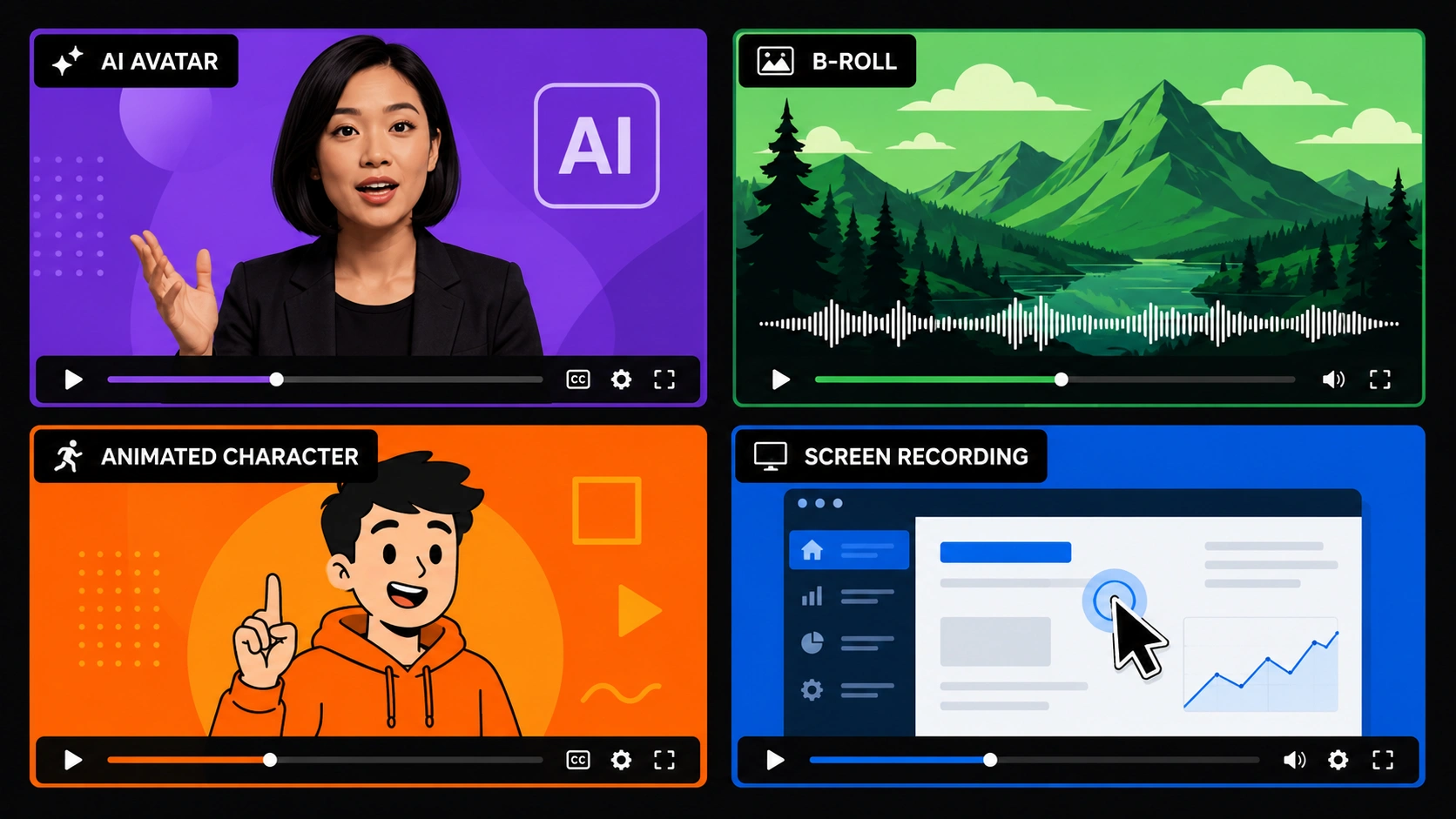
An AI faceless video maker is any tool that produces finished video content without requiring the creator or brand to appear on camera. It works by replacing the human presenter with one of four approaches: an AI-generated avatar speaking to camera, B-roll footage or stock visuals with an AI voiceover, animated characters or explainer graphics, or a screen recording with narrated audio. The best tool for a given use case depends almost entirely on which of these four approaches the content requires.
The four approaches — and why they're not interchangeable
Before ranking tools, it's worth being precise about what "faceless" actually means for your content, because the four approaches produce fundamentally different outputs.
AI avatar video puts a synthetic human face on screen — a generated character that speaks your script with lip-sync and facial movement. The viewer sees a person; it just isn't you. This is the right approach for testimonial-style content, product explainers where a presenter adds credibility, and AI UGC ad creative for performance marketing. The face is part of the format's persuasive mechanism.
B-roll with narration uses stock footage, AI-generated visuals, or product imagery as the visual layer, with an AI voiceover carrying the message. No face on screen at all. This is the dominant format for YouTube faceless channels — finance, tech, history, listicles — where the narration is the content and the visuals illustrate it.
Animated explainer uses illustrated characters, motion graphics, or animated scenes in place of any live footage. Strong for educational content, product walkthroughs, and corporate training where the subject matter is complex and benefits from visual diagrams rather than a speaking head.
Screen recording with voiceover captures software, apps, or browser interfaces with a narrated walkthrough. Standard for SaaS tutorials, app demos, and how-to content where showing the product in action is more useful than any presenter explaining it.
The ranking — by use case
ButterCut — best for AI avatar faceless ad creative in Indian languages
For Indian D2C brands specifically, ButterCut is the faceless ad creative solution that addresses the problem generic avatar tools don't: the AI character needs to look and sound like it belongs in front of an Indian audience. A faceless ad that uses a Western-presenting avatar with American-accented Hindi defeats the purpose of the format. ButterCut builds Indian-presenting characters with native Indic language delivery across Hindi, Tamil, Telugu, Bengali, Marathi, Kannada, and Malayalam — making the "faceless" format work the way it's supposed to for Indian performance marketing. The pipeline is managed rather than self-serve, which means the briefs-to-Meta-ready output flow handles script, character selection, and platform formatting as one workflow rather than five separate decisions.
Creatify — best self-serve AI avatar for high-volume ad testing
Creatify is built specifically for e-commerce performance ad production. The URL-to-video workflow turns a product link into a batch of UGC-style avatar ads in minutes, with 1,500+ ad-optimised avatars including Avatar Aurora at 24fps lip-sync and a product-holding feature that lets avatars physically present items. At $39/month for the Creator plan, it's the most practical self-serve option for a brand that needs volume of faceless ad variants. The limitation for Indian brands: avatars are primarily Western-presenting, and Indic language depth is thin despite Hindi being listed among supported languages.
Synthesia — best AI avatar for corporate and training faceless content
Synthesia's Starter plan runs $18/month billed annually ($29 monthly) with the Creator plan at $64/month. It's the established enterprise choice for HR, L&D, and corporate comms — training videos, compliance content, onboarding modules — where a professional-looking presenter adds credibility and the content needs to be produced at volume without scheduling a real person. The avatar quality is high; the credit system is where costs climb faster than the sticker price implies, and the platform's content moderation flags healthcare and regulated industry content without a clear appeal process.
InVideo — best for B-roll with narration faceless content
InVideo's Plus plan starts at $25/month and covers the B-roll-plus-narration approach better than any avatar-focused tool. A script goes in, the AI selects relevant stock footage from a large library, and an AI voiceover carries the narration. This is the workflow behind most YouTube faceless channels covering finance, tech, and educational topics. The trade-off is that InVideo's stock footage skews toward Western visuals, which limits its effectiveness for Indian-audience content where local context in the B-roll matters. For English-first, internationally-oriented faceless channels, it works well; for Indian regional content, the visual library becomes a genuine constraint.
GenFaceless — best for quality-first YouTube faceless channels
At $20/month for 30 videos, GenFaceless targets the B-roll-with-narration YouTube channel use case specifically. Independent testing has noted its script quality as meaningfully better than competitors on the same prompt — better hooks, smoother transitions, more engagement-optimised structure — with automated video assembly that matches stock footage to script context with notably higher accuracy than generic tools. It targets YouTube specifically rather than trying to serve every platform, which makes it focused but limited for short-form social or ad creative use cases.
AutoShorts — best for automated faceless short-form posting
At $29/month, AutoShorts handles the fully automated end of the faceless video spectrum — enter a topic, the AI generates script, visuals, and voiceover, and posts to YouTube and TikTok on a defined schedule. It's the right tool for creators who want faceless channel output on autopilot rather than a production tool they manage actively. Quality is lower than GenFaceless by most independent assessments, and customisation is limited. The value is in the automation and scheduling, not in output quality per video.
Comparison table
| Tool | Approach | Starting price | Best for | Honest limitation |
|---|---|---|---|---|
| ButterCut | AI avatar (Indian-presenting) | Contact for pricing | Indian D2C ad creative in Indic languages | Managed service, not self-serve dashboard |
| Creatify | AI avatar (ad-optimised) | $39/mo | High-volume e-commerce ad testing | Thin Indian language depth; USD billing |
| Synthesia | AI avatar (corporate) | $18/mo (annual) | Training, HR, corporate comms | Credit costs climb fast; content moderation issues |
| InVideo | B-roll + narration | $25/mo | English-first YouTube faceless channels | Western-skewed stock footage library |
| GenFaceless | B-roll + narration | $20/mo | Quality-first YouTube faceless content | YouTube-specific; limited social or ad use |
| AutoShorts | B-roll + narration (automated) | $29/mo | Automated daily faceless posting | Lower quality ceiling; minimal customisation |
Where each approach works and where it doesn't
AI avatar video
- Works: Performance ad creative where a presenter format drives credibility; testimonial-style content; product explainers where a human face increases trust
- Doesn't work: Long-form YouTube content where the same synthetic face for 10 minutes becomes obvious; categories where viewers specifically want proof a real person had an experience
B-roll with narration
- Works: Faceless YouTube channels covering educational, finance, or tech topics; any content where the information is the value, not the presenter
- Doesn't work: Indian regional content where local visual context matters; ad creative where a direct-to-camera presenter format outperforms stock footage
Animated explainer
- Works: Complex product or concept explanations; corporate training where diagrams aid comprehension; content where no stock footage exists for the subject
- Doesn't work: Content where relatability and perceived authenticity matter more than visual clarity
FAQ
What is the difference between a faceless video and a talking head video?
A talking head video has a face on screen — either real or AI-generated. Faceless video has no face at all: it uses B-roll, stock footage, animation, or screen recordings with a voiceover. AI avatar tools produce talking head videos, not technically faceless ones, though they're often marketed under the faceless category because the person creating the content doesn't appear on camera.
Can AI faceless video makers produce content in Hindi or Indian languages?
Most tools list Hindi as a supported language, but quality varies significantly. Generic tools produce stilted delivery and miss code-switching entirely. Purpose-built Indic language pipelines handle natural Hindi, Hinglish, and regional accent delivery — which matters most for faceless ad creative targeting Indian consumers rather than YouTube content where audio naturalness is secondary to information delivery.
Which faceless video approach works best for ads?
AI avatar video — a synthetic presenter speaking directly to camera in UGC style — consistently outperforms B-roll plus narration for performance ad creative, because the testimonial format's persuasive mechanism depends on a person appearing to endorse the product. B-roll with narration is better suited to content marketing and organic social than paid performance ads.
Is faceless video content allowed on Meta for ads?
Yes. Meta permits AI-generated avatar ads as long as they comply with platform ad policies and, increasingly, AI content disclosure requirements that are tightening through 2026. India's ASCI draft guidelines from May 2026 also move toward mandatory disclosure for AI-generated advertising content.
Faceless video is not one format — it's four distinct production approaches that serve different content goals. AI avatar video works for testimonial-style ads and presenter-format content. B-roll with narration works for YouTube educational channels. Animated explainers work for complex product or training content. The tools that win each category are different, and choosing a tool from the wrong category is more expensive than choosing the wrong tool within the right one. For Indian D2C brands running performance ads, the avatar approach is the right category — and the specific challenge is finding an avatar tool that produces Indian-presenting characters with natural Indic language delivery.
If you need faceless AI ad creative that looks and sounds native to Indian audiences rather than a Western avatar with translated audio, ButterCut is built for exactly this. Book a free demo to see it on your brief and language requirements.
Sources
- SIIT, Top 5 Faceless AI Video Generators in 2026 — GenFaceless $20/mo, Faceless.Video $19/mo, InVideo $25/mo
- SyncStudio, Best AI Faceless Video Generators — Pictory $23/mo, AutoShorts $29/mo
- HeyGen Blog, Best AI Video Generator for Faceless YouTube 2026 — Synthesia $18-64/mo pricing
- Kineclip, Top AI Tools for Faceless Content Creators 2026 — AutoShorts $29/mo
- VidMetoo, HeyGen vs Creatify Comparison 2026 — Creatify avatar features and pricing