



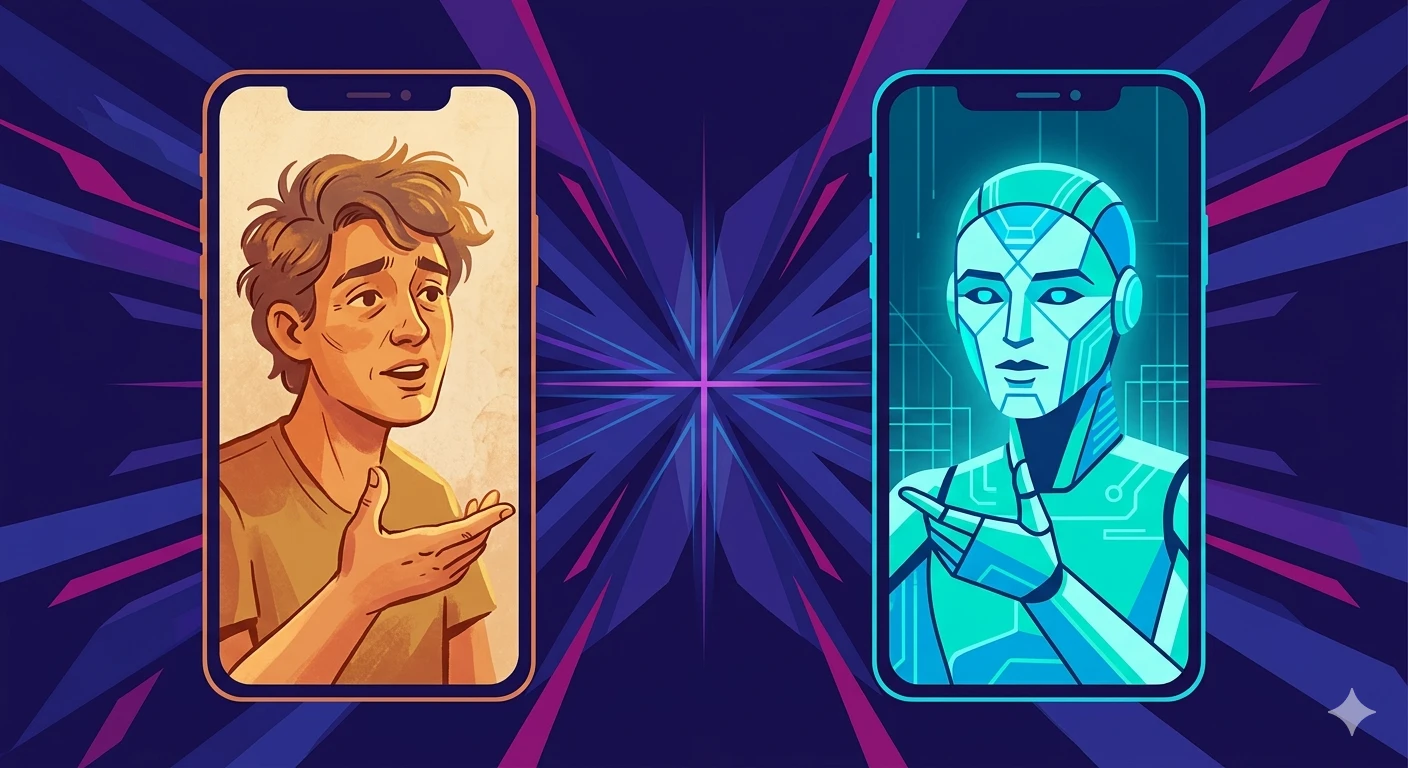
Every conversation about AI UGC eventually arrives at the same uncomfortable question: if the entire point of UGC was that a real person had a real experience, what's left once you take the real person out?
Removing the human from a UGC ad means replacing a filmed creator with an AI-generated character delivering the same testimonial-style script. It works by keeping the format, tone, and visual language of real UGC while changing who or what is on screen. What's gained is consistency, speed, and freedom from creator usage-rights cycles. What's lost is the specific kind of trust that comes from a viewer believing a real person actually had the experience being described.
What actually breaks
The trust mechanism behind UGC isn't really about video quality, it's about inference. A viewer watching a slightly imperfect, handheld testimonial unconsciously reasons: a real person took the time to say this, so it's probably at least somewhat true. That inference is the entire product. The moment a viewer suspects the person on screen isn't real, the inference collapses, and the claim being made loses the credibility it borrowed from looking like organic proof.
Research on this exact dynamic is fairly consistent. Lippincott's consumer trust research found that 46% of people trust a brand less specifically after learning AI was used to deliver something they assumed came from a human, and broader analysis describes this as a documented trust penalty rather than a fringe reaction. Critically, the research suggests the deception is what damages trust, not necessarily the AI itself; brands that are upfront about using AI tend to face a smaller penalty than brands caught using it without disclosure.
Warmth and imperfection are the second casualty, and they're harder to fix than trust. Real testimonials have stumbles, half-finished thoughts, and small tonal shifts that signal someone speaking off the cuff rather than reading a script. Even well-produced AI characters tend toward a slightly too-smooth delivery, since the underlying technology is built to render coherent speech, not to convincingly fake the specific imperfection of someone thinking while talking.
What actually gets gained
The most underrated benefit isn't speed, it's the removal of usage rights as an ongoing cost and risk. Real creator content typically comes with licensing terms lasting six to twelve months, after which the brand needs to renegotiate or stop running the ad, and copyright in creator content vests automatically with the creator the moment it's filmed. A brand that wants to keep running a strong-performing creator video past its license term either pays a renewal fee or loses the asset, and brands that assume a tag or a repost constitutes a license have been caught out by exactly this gap before. AI-generated content sidesteps this entirely; there's no creator whose rights expire on a clock.
Consistency is the second real gain, and it compounds in ways that aren't obvious until a brand is running fifteen or twenty creative variants a month. Every human creator brings their own interpretation to a brief, which means brand messaging discipline depends on how well each individual creator executes it. An AI character delivers exactly the script it's given, every time, which removes one entire axis of variability from a testing program, for better when consistency is the goal and for worse when a slightly different human delivery might have been the thing that worked.
Where the two formats actually compete, and where they don't
The honest framing isn't AI versus human, it's that the two formats are frequently used to solve different problems, and brands lose when they apply the wrong one to the wrong job. Using AI UGC for a category where the entire value proposition is "a real person vouches for this," like a weight-loss transformation story or a health claim, asks the format to do something it structurally can't do: manufacture the specific kind of trust that only comes from believing a real experience happened. Using a real, expensive human creator to test the fortieth minor hook variation of an already-validated angle wastes the thing humans are actually good for, original judgment and delivery, on a task that's really just systematic permutation.
Where it works
- High-volume hook and angle testing, where consistency and speed matter more than any single video's emotional depth
- Categories where the product claim, not the messenger's perceived life experience, is what needs to land
- Multilingual scaling, where the alternative is finding and managing native-speaking creators across every target language
Where it doesn't
- Health, wellness, and transformation content, where audiences are primed to look for proof of a real experience
- Hero brand assets meant to build long-term emotional equity rather than drive an immediate click
- Any execution where the brand isn't prepared to disclose AI use, given that concealment, not the technology itself, is what drives the steepest trust penalty
FAQ
Do AI UGC ads feel less trustworthy than human-made ones?
Research finds the trust penalty is tied more to undisclosed AI use than to AI itself. Transparent use of AI tends to face a smaller trust cost than concealed use.
What's the biggest practical advantage of removing the human creator?
Avoiding the ongoing cycle of usage-rights renewal and renegotiation that comes with licensed creator content, alongside the ability to produce consistent output at volume.
Can AI UGC ever fully replace human creators?
Unlikely for categories where the ad's entire credibility depends on a viewer believing a real person had a real experience. The two formats are built for different jobs.
Does disclosing AI use hurt ad performance?
Evidence is mixed on immediate click performance, but concealment carries a larger documented trust cost than disclosure, which matters more for long-term brand perception than any single campaign's CTR.
Removing the human from a UGC ad trades a specific kind of borrowed trust, the inference that a real person really had this experience, for consistency, speed, and freedom from creator usage-rights cycles. The data suggests the real risk isn't AI itself but concealment: brands caught hiding AI use face a steeper trust penalty than brands that are upfront about it. The two formats aren't really competitors. They're often the wrong tool used for each other's job, AI asked to manufacture trust it structurally can't produce, and human creators hired to do repetitive testing that doesn't need their judgment.
If your team is trying to decide which parts of your UGC production should stay human and which should move to AI, book a free demo with ButterCut to talk through where the line should sit for your specific category and audience.